Jay Sachetti joined Jeff O’Brien, partner at Husch Blackwell and Dyanne Ross-Hanson, president of Exit Planning Strategies talked about the market for mergers and acquisitions, exit planning opportunities for companies that don’t end up for sale and how companies can maximize their eventual sale price during an early October panel at the first Upsize on Tap event at Summit Brewing Co. in St. Paul.
When the state Legislature passed a law requiring employers to provide paid leave and safe time for employees, Justin Bieganek started hearing differing details from friends, colleagues and peers.
Contingency planning for disasters can make or break a company
We routinely read news stories about tornados, hurricanes, floods, earthquakes, fires, computer viruses, ransomware blackmail and the list goes on. These events should provide sufficient motivation for business owners to create business continuity plans. Yet, many do nothing.
If you are old enough, ponder the disruption caused by the 9/11 terrorist attack. That event alone completely changed the way we live and the way we do business. Now comes the COVID-19 pandemic. Once again, our lives and the ways we do business are completely altered. Countless businesses have failed as a result.
What will happen to us next? Consider the impact of an attack on our power grid, a “European-style” extended labor strike in the U.S., or a biotechnology accident that contaminates the water supply. If COVID-19 has taught us anything, it is the necessity to have a plan for crisis situations.
Definition
Business continuity planning is the process a company undergoes to create a prevention and recovery system from potential threats such as natural disasters, cyber-attacks, terrorism and any other crisis of a similar nature. The plan is designed to protect personnel and assets and make sure they can function quickly when disaster strikes. A well-developed plan, and subsequent implementation reduces panic and may ultimately be the difference between business survival and business failure.
The primary objectives of a business continuity planning process include:
Ensuring the continuity of business operations during a crisis
Ensuring employee safety during a crisis
Ensuring continuity of key IT systems during a crisis
Minimizing customer impact from business disruption
Minimizing reputation damage from an incident
Components
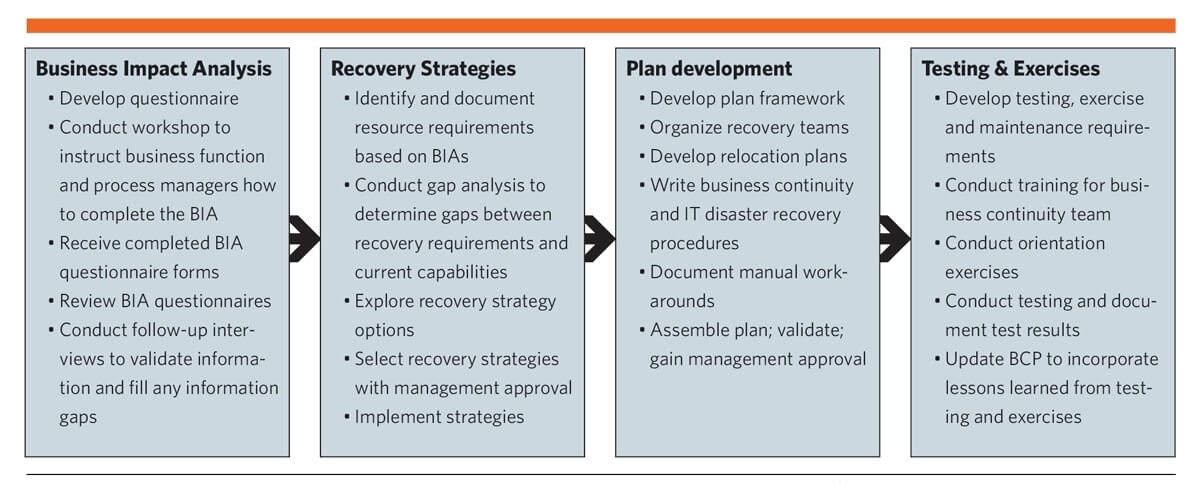
Business Impact Analysis.A business impact analysis (BIA) supports the entire business continuity process. It is a process used to identify, quantify and qualify the impact of a loss, interruption or disruption. A BIA identifies mission-critical activities and the time frame within which they must be recovered. Explore all the risks that your business is exposed to and the possible major disruptions that could occur. And don’t forget about your suppliers. Could you still operate if your top vendors closed due to a disaster? Consider the actions needed for your practice to remain operational. Plan alternatives for your critical supplier dependencies.
Recovery strategies: After the BIA, the business should mitigate risks that threaten the health and safety of people, operations, customers, company assets or the environment by reducing the risk to an acceptable level. Strategies should be developed, and may include security and fire protection systems, vendor readiness and qualification of secondary suppliers, IT backup strategies and direct response sites, splitting critical functions and resources between multiple sites, mutual aid agreements with other businesses, work-at-home strategies, manual and alternate procedures if computer systems are down, and cross-training of personnel among others.
Written plan communicated to employees: Record everything in the BIA process and develop a written plan for disasters and emergencies. At a minimum, the plan should include key roles and responsibilities, BIA results, risk mitigation plans, off-site data and storage requirements, business recovery and continuity strategies, plan activation and universal response, communication and notification plan, and training, drills and exercises.
Training and Testing. Conduct training for employees with key roles and assignments in the business continuity, disaster recovery and incident response processes. Testing is the generic term used to describe the critical process of exercising strategies and plans, rehearsing with coworkers and testing systems (technology infrastructure and administrative) to demonstrate business continuity.
Resources
In this case, your federal government can help. Its website has excellent information for those who wish to build a business continuity plan.
The internet is a vast library of material on business continuity planning, from step-by-step approaches to sample plan templates. The only obstacle for you, as a business owner, is making time to prepare a plan for the unexpected. If you are short on time, there are many consulting firms you can engage to assist you with the process.
One Final Thought
While you are putting together a continuity plan for the business, don’t forget to consider its most important asset – you. Successful business owners are usually optimistic people and often are averse to dwelling on the more unpleasant aspects of business. Contemplating your own demise certainly qualifies as an unpleasant aspect. Floods, fires and pandemics are awful events, but the loss of you could be the most disruptive and devastating occurrence for your business. Part of your process should include a plan for continuing the business without your participation.