Jay Sachetti joined Jeff O’Brien, partner at Husch Blackwell and Dyanne Ross-Hanson, president of Exit Planning Strategies talked about the market for mergers and acquisitions, exit planning opportunities for companies that don’t end up for sale and how companies can maximize their eventual sale price during an early October panel at the first Upsize on Tap event at Summit Brewing Co. in St. Paul.
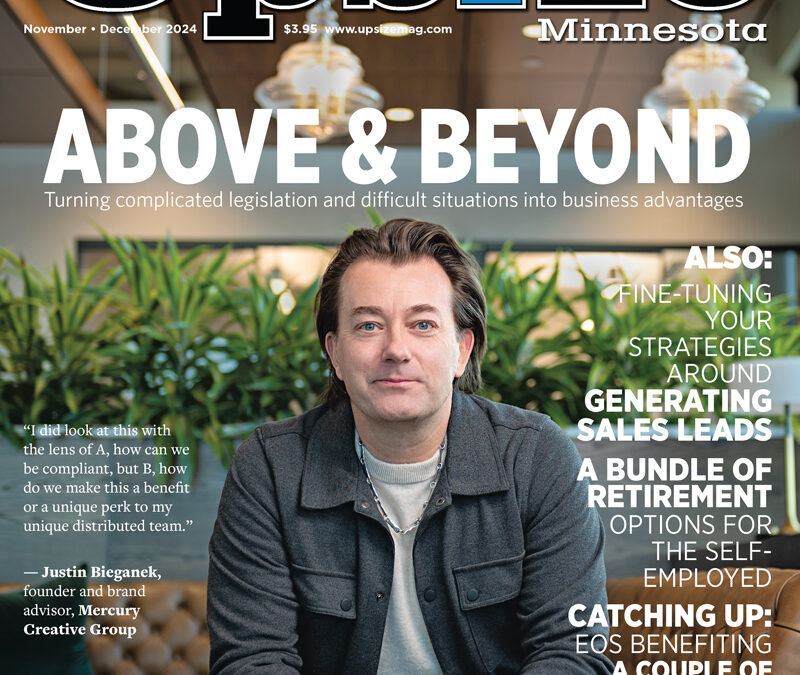
When the state Legislature passed a law requiring employers to provide paid leave and safe time for employees, Justin Bieganek started hearing differing details from friends, colleagues and peers.
The Upsize Growth Challenge, presented by Winthrop & Weinstine, was designed by Upsize magazine to match two winning business owners with the expert advice they need to reach their goals.
Winners, selected based on the ambition of their growth and the quality of work they’ve completed, meet twice with a panel of experts.
During the first they share plans and receive advice. Then, two months later, they meet again, sharing their progress and getting a final round of thoughts from
the expert panel.
In mid-August, NSN-BabySoft LLC and Wilcraft gathered with a panel of experts sharing their growth challenges with a panel of experts assembled to help them solidify their plans.
Six weeks later, the group reconvened in the offices of Winthrop & Weinstine in downtown Minneapolis for an update and a final round of advice.
Progress on baby band movement
NSN-BabySoft, which is attempting to gain traction as the exclusive U.S. distributor of a softer, gentler identification band that company officials say would prevent cuts and irritation on babies and, as such, reduce the risk of infections at a cost not significantly higher than what hospitals use now, was active during the interim.
Based on the advice of experts, co-founders Vicki Sheaffer and Ellen Roeser, spent considerable time updating the company’s presence on the Internet.
Previously, NSN-BabySoft was marketed primarily on the site of North Star Newborns, an in-home infant care provider. Experts felt the bands needed to be set apart more.
So, they established separate Facebook and LinkedIn pages, updated the logo and began using social media to tout the benefits of their product, particularly emphasizing the risk of infections present with the current products, they say.
They’ve also been hunting down statistics on statewide hospitals, in particular seeking out independent hospitals that aren’t associated with larger systems. They think there’s a better chance of getting face-to-face with decision makers in such venues.
“We have made contact with 21 of 34, some in person, some via email, some over the phone,” Sheaffer says, adding that they’ve only received two firm “no”answers to their inquiries. “There is interest from the personnel we have contacted. They are working to take it to the next level. Hopefully that will be an in for that beta test trial.”
They’re exploring the possibility of finding a partner to help navigate some of the larger systems and also are looking into meeting with large medical suppliers that service hospitals.
“This is a whole different avenue and a whole different beast to tackle,” she says. “They know the inner-workings of someone who has been within a large medical supplier. They know the inner-workings of what it would take to be a menu offering.”
And, Roeser says, NSN-BabySoft plans to step up its plans for attending expos, conferences and other forums where there may be an in. Experts were generally positive about the product itself and the work they’d done, though they expressed a bit of concern about the market size.
Expert insights
Andy Schornack, CEO of Flagship Bank, questioned whether there are enough babies born in a year to make the finances work. “If you’re making $1 per band, profit over cost, you’ve got to think what can I spend on these other things and still maintain a profit we’re comfortable with,” he says
Even with tremendous market share, upside revenue potential gets capped pretty quickly, which could diminish the chances of attracting investors, adds Dean Willer, chair of the corporate practice group at Winthrop & Weinstine.
Roeser and Sheaffer understood the challenge, but add that they think once they get through testing the product on infants, hospitals may see the value in expanding their use to other parts of the hospital.
They may also be able to go into senior care facilities at some point.
“I think this band is so good there is potential for them to use it throughout the hospital for all patients, burn victims, the elderly,” Roeser says.
“Once they use it and see how good it is it becomes a favorite and is used throughout the hospital.”
While Roeser and Sheaffer say they have a great relationship with the United Kingdom-based band manufacturer, Willer also cautioned that they should ensure they get a contract that protects them against doing the work to break in to the market only to be replaced.
“If I were in your shoes I would want to lock up your supplier and get a contract that allows you to renew unilaterally based on some objective metric — volume, sales, payment amounts, etc. — so that when you prove concept, the supplier can’t say ‘you did a great job, now we’re going to replace you,'” Willer says.
Schornack suggested not waiting too long to see if it might take moving to another market – perhaps the elderly – to prove the efficacy of the bands
“You want to make sure the ultimate capacity is something you’re willing to spend time on,” he says.
Diane Paterson, associate director of the Small Business Development Center in the Opus College of Business at the University of St. Thomas, suggested one next step might be taking some of the research the company has done and submitting it as an article to a parenting magazine.
“Maybe Shop it to Parent Magazine or something where your target customer is reading those articles and has some serious concerns they may bring to their medical professionals,” she says.
Breaking the ice
While much of the state is lamenting the end of fall and prepping for winter, Tom Roering, president of Wilcraft, can’t wait for cold weather. The manufacturer of the water, ice, land vehicle known as Wilcraft, also spent the six weeks after the initial meeting enhancing his growth efforts.
Some of the work wasn’t sexy.
Partially in response to concerns raised by experts at the August meeting, he spent the summer documenting processes to make it easier to hire people to take on some of the tasks he currently handles himself.
“As you mentioned, [the company] is me,” he says. “If I’m gone, it’s gone.”
As he attempts to ramp up growth with the goal of selling the company in a few years, he also took steps to establish a consumer financing program and to hire some management and sales people to lessen his responsibilities.
Along those lines, he’s hired a new accountant, who may become the company’s controller after a probationary period. He’s interviewed a few sales people, as he acknowledges that is not his forte.
“We need to hit the road,” he says. “We need to visit the resorts, we need to do shows. We also need to put on a more professional face.”
And he’s interviewed some videographers, with plans to shoot some videos that can be used on various social media and web platforms – though they can’t shoot much for him until there’s actually ice.
He also acknowledged after doing a poll on the company’s Facebook page that experts were correct in concluding that the main factor preventing potential buyers from completing a transaction is the need to see, touch and feel the product.
Pricing can be a challenge, but that’s usually overcome when people actually get a chance to see the vehicle up close, Roering says.
“It’s all about getting the vehicle out in the public at locations where people can see them,” he says.
To that end, distributors have stepped up, agreeing to take their Wilcrafts to several shows. And Roering says he’ll do a few more, as well.
Wilcraft also is working to establish an ambassador program where previous buyers provide their contact information and allow those considering a purchase to contact them in exchange for some apparel or, possibly, cash.
“Those people are so proud of their machines they’re happy to talk about it,” he says. “We’re looking forward to implementing that.”
Expert thoughts
The panel of experts liked several of the steps he’s taken.
“I think you’re focused on the right things,” Schornack says, adding that increasing the dealer network is a sound avenue toward greater sales. And requiring cash down payments can help the company grow with minimal need for outside financing, he adds.
He adds that the ambassador program coupled with the social media efforts, in much the same way Harley Davidson does, will build a following. “It’s not about the Harley, it’s about the experience.”
Paterson also was intrigued by the ambassador program.
“It builds community, that’s what you’re building through ambassadorships and shows,” Paterson says. “The pride these owners have because they love their vehicles is building a community much like Airstream did with their trailers.”
She also praised the steps Roering has taken to remove some of his responsibilities.
“The business is so owner dependent,” she says. “That’s a huge risk.”
Jon Austin, senior partner at J Austin & Associates, expressed some concern that Roering is still heavily involved in manufacturing the units. Roering says that’s his forte and that he’ll always have a hand in that part of the business.
“One of the perks of being the boss is that you can pick and choose what you do,” Austin says. “But all of the rest of the business depends on you too, so when you’re putting together one of your units, you’re not selling, you’re not arranging financing, you’re not supporting dealers who are doing shows.”
He does like the ambassador program and working with dealers to attend shows as ancillary opportunities. But he reiterated a point made in the earlier meeting that bringing on a couple commission-based sales people and assigning them to do nothing but selling at shows might be his best avenue for significant growth.
“When people see and touch and are face-to-face with the machine is when they buy it,” he says. “I keep coming back to …
I think the real opportunity to boost sales and to line up distributors is to put a couple teams on the road with a trailer and some professional booth-ware.”
Consumer financing, leasing, anything that makes sales easier is the answer, says Willer, adding that it might make sense to spend some money on a market study to see just how big the potential sales could be.
“Given it is a niche product, it might be worthwhile making a small investment in a market study, which would help you make some critical decisions, like whether investing in a phenomenal sales organization would genereate the sales volume you’re anticipating or whether you’re targeting the best market segments.”
DIANE PATERSON, associate director of the Small Business Development Center in the Opus College of Business at the University of St. Thomas: 651.962.4503; di************@******as.edu; www.stthomas.edu.