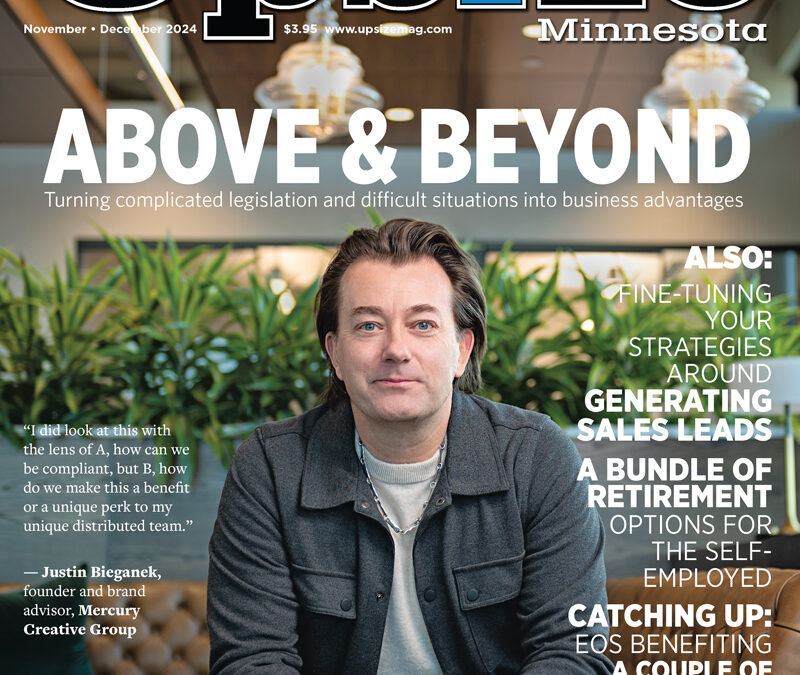
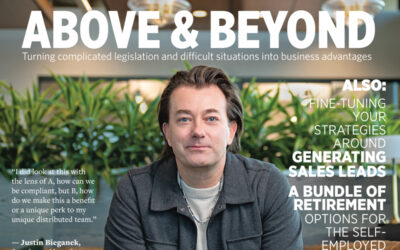
When the state Legislature passed a law requiring employers to provide paid leave and safe time for employees, Justin Bieganek started hearing differing details from friends, colleagues and peers.
He knew he needed to get educated.
“There were all these mixed feelings,” he says. “Why do we have to do this? This is going to kill us.”
At the same time, Bieganek, founder and brand advisor at Mercury Creative Group, tries to make his remote brand strategy and design firm an employee-friendly place where people want to work. Further complicating the issue for him: He has employees located in several states outside Minnesota.
“What I had to do initially was get informed,” he says. “I really needed to take a look at all of those states and that was something that was unique.”
He’d worked previously on another project with Steve Schad, president of the fractional HR firm Optima HR Solutions and he reached out again for some clarity and assistance in figuring out how to comply while also not draining the firm of resources.
“I did look at this with the lens of A, how can we be compliant, but B, how do we make this a benefit or a unique perk to my unique distributed team that goes from part-time to full-timers,” Bieganek says.
Finding solutions
Together, Schad and Bieganek worked out a plan under which the company won’t track vacation time, opting instead for an open policy. It includes stipulations relating to the length of time a worker can be off at any one time and time off still requires approvals, so there are boundaries.
But it’s also a plan that builds off of a culture that Bieganek saw an opportunity to illustrate through this new policy.
“We have a really strong culture of trust and transparency here,” he says. “I know all of my employees, so being able to go through that process understanding ‘What’s Julie going to need, what’s she going to want, how is she going to respond to this? How is Karen going to respond to this,’” he says. “It really just comes down to let’s all work together to make things great for all of us and respect the business and respect the people.”
The new rules will kick in on Jan. 1. Bieganek likes the new approach because it goes beyond the requirements of the state law and because it’s simpler to enact. He thinks his employees will like the flexibility.
Optima’s Schad, who advised Mercury Creative, says headwinds for entrepreneurs seem to be getting stronger with boomers retiring shrinking the workforce, participation rates lagging and government regulations becoming a patchwork effort.
In Minnesota, the controversial earned sick and safe time law requires employers to provide paid leave to employees who work in the state that can be used if they are sick, if they have to care for a sick family member or if an employee or family member has experienced domestic abuse, sexual assault or stalking, according to the Minnesota Department of Labor.
“Some states and localities are enacting more and costly rules that favor employees,” Schad says. “This is on top of federal rules that never let up.”
As usually happens, he adds, Mercury and other small businesses have found ways to make it work. Some have started looking at employee stock ownership programs and other ways to financially give employees a stake. Others, like Mercury, have pushed the ceiling on time off.
“Many employers are finding success by treating the new rules as a minimum to go above and beyond,” says Schad, adding that creating such programs starts with a firm understanding of what the rules are and what compliance looks like.
“If I’m an employee and I say I’m sick, you have to just accept that and you have to give them time off. There’s no notice requirement.”
So, as an employer, Schad says you need to put in place rules around what is considered safe and sick time and what is considered part of an unlimited PTO allotment.
It helps, he adds, to consult with an HR professional to ensure compliance, but the end result can be great.
“It is kind of a win-win, where the employee gets this great benefit of unlimited PTO and the employer gets to advertise that at the same time,” Schad says. “That’s an example of turning the lemons to lemonade.”
Communicate
Sara Schlipp-Riedel is director of human resources working remotely from Minnesota for New Jersey-based Accordant Co. LLC, an enterprise resource planning software vendor. She also owns Leora Leadership Consulting, which helps nonprofits establish human resources policies.
She says businesses of all sizes struggle with balancing the need to recognize the humanity that inevitably comes with having employees versus the need to have consistent policies that apply to everyone fairly and equally.
The advantage for smaller businesses, she says, is agility — the ability to provide some flexibility “or even customization in terms of recognizing the human component of what it is to be a professional today, no matter what stage of life you’re in.”
Schlipp-Riedel regularly has discussions with her mother, who worked while raising a family, about how different it is today in that parents can often chaperone field trips or attend programs at school without upsetting employers.
“She will ask me questions like, ‘Your employer was okay with that? And your colleagues don’t get upset with you?’” Schlipp-Riedel says. “I think smaller organizations have an opportunity to recognize that, to really embrace that, to support that. And that goes a long way for employees.”
There are challenges there. Some employees with kids may be treated differently than others who don’t have children. But those employers can address that by providing time off for those without children to do something else that might help them feel fulfilled.
“So, if Jane wants to step out and volunteer in the classroom, maybe you can also turn to Melissa and say, ‘Hey, you know, we really want to give you the space. If it’s important to you a … to go and do something that’s important to you a couple hours a week, do something that fills your cup.’”
Putting practice to culture
The opportunity for small businesses to set themselves apart as worker friendly can be put to the test when it comes to something longer-term, such as caring for an aging parent, dealing with death or an illness, or other reasons that might take an employee away for an extended time.
But Bieganek, Schlipp-Riedel, Schad and others indicate these are the times when a company can put actions behind the words of their culture.
“Those are moments of impact for an organization,” says Schlipp-Riedel. “How an organization, how an organizational leader responds in those moments really sets the tone and probably says a lot to whoever is a part of the organization about their perspective on what’s life really about, what’s most important.”
Tyler Arvig, associate chief clinical officer and vice president at R3 Continuum, says larger companies may have access to more resources, such as Employee Assistance Programs, that smaller businesses don’t have access to. And in those larger settings, one person’s absence might not have the same kind of impact that it might in a smaller office.
There are ways for small businesses to help their people. What it looks like depends.
“It depends on what the role is,” he says. “Do you have the people that can cover, people that can flex in their job duties to cover for that person?”
Then it’s important, he adds, that when the person does return to work after an extended leave that work has gotten done on their behalf.
“There’s nothing worse than coming back to work and then finding out that, ‘Oh, geez, nothing got done while I was ‘gone,’” Arvig says. “You don’t want people to come back into a work environment and feel like they have clean-up to do.”
Bieganek says he’d focus on communication, pulling the person aside to better understand and assess the situation to figure out how to rebalance resources to provide the space necessary while trying to maintain workflow, as well.
“Life happens sometimes,” he says. “Horrible things happen. We’re emotional beings so being alongside that person on whatever unfortunate journey may be happening, and staying as close as you can to help and even sometimes just being there, is the most important thing.”
Don’t forget the executive team
Arvig adds that often times lost in these situations is that upper ranking executives, whether at small businesses or large corporations, sometimes need services too — but often don’t feel they can take the time away.
R3 Continuum is seeing a lot of traction with mental wellness counseling that allows top executives to get support from well-trained mental health professionals with backgrounds in how business works through virtual appointments over a lunch hour or other convenient times.
“Maybe I don’t even need to leave the office necessarily to do it,” he says. “We’ve seen just great feedback from folks who were really struggling with stuff and the employer offers that. There’s some cost to the employer, but what’s the cost versus the cost if I take two months off of work and I’m not there? That’s a pretty big cost too. So, am I going to invest in supporting my people in a really more intensive way that they can feel supported and continue to help my company?”