Jay Sachetti joined Jeff O’Brien, partner at Husch Blackwell and Dyanne Ross-Hanson, president of Exit Planning Strategies talked about the market for mergers and acquisitions, exit planning opportunities for companies that don’t end up for sale and how companies can maximize their eventual sale price during an early October panel at the first Upsize on Tap event at Summit Brewing Co. in St. Paul.
When the state Legislature passed a law requiring employers to provide paid leave and safe time for employees, Justin Bieganek started hearing differing details from friends, colleagues and peers.
Shifting on the fly gives business owners a chance to pull through difficult times
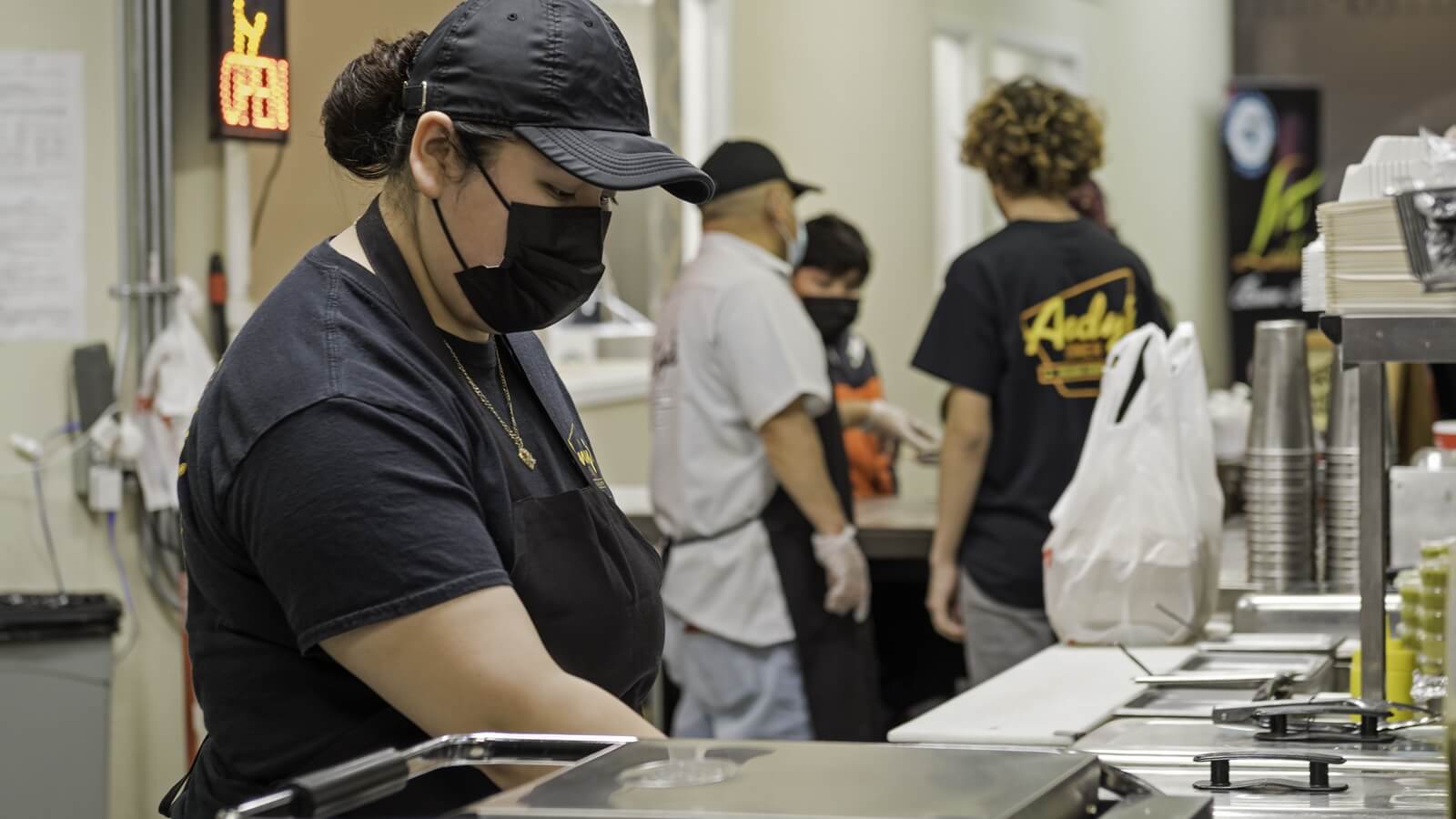
Inearly 2020, things were looking good at Andy’s Garage, an American food diner at the Midtown Global Market in Minneapolis. Following a strong 2019, the company was off to another good start.
“We were going for our best year ever,” says owner Frank Chase.
Then it disappeared. Big time. The COVID-19 global pandemic hit and everything shut down.
Literally.
Gov. Tim Walz, in mid-March, ordered bars, restaurants, health clubs, theaters and other public gathering places to temporarily close to fight the spread of the virus. Restaurants were among the hardest hit and, in Chase’s case, he lost one of his most regular sources of customers when a large health care organization in the same building ordered its employees to start working from home. Chase had to shut down not just Andy’s Garage, but also Andy’s Diner, a similar venue he had just opened in Uptown.
But Chase refused to give up. When able, he re-opened, but with a twist. He’d sold only American food before COVID hit. During the downtime, he added some Mexican fare, specializing in small handheld items like tacos, burritos and tamales that were compatible with takeout or a very quick sit-down meal.
The change hasn’t made him whole, but as of early March 2021 sales were at about 60% of his 2019 sales. Not great, but enough to give him optimism that he’d be able to wait out the remainder of the pandemic. The Mexican food items now account for around 30% to 40% of his daily sales.
“We’re seeing that people want that category of food right now,” Chase says, adding that the shift on the fly has allowed him to keep his employees working. “I count my blessings every day. … We truly enjoy cooking and seeing our customers happy.”
From wood to plastic overnight
Chase was just one of countless small business owners crushed by the sudden onset of COVID-19. Many did not make it through. But some who did survive found creative ways to change up their businesses on the fly.
Woodchuck USA, for example, is a 9-year-old manufacturing company that typically designs and makes wooden gifts, journals and flasks for the corporate gift market.
That market largely disappeared when the virus arrived and Woodchuck had furloughed half of its 50 workers. Chairman and founder Benjamin VandenWymelenberg says the survival of his business was in doubt.
Then the company’s fortunes changed again, literally overnight, when a friend got a call from a contact at Allina Health wondering if Woodchuck could start making plastic face shields.
“Sunday night he came over to the manufacturing shop,” VandenWymelenberg says. “We cut up a mock up and taped it together. He sent it to his contact at Allina and they said ‘Yep, we’ll take 5,000.’”
Monday, he hired everybody back.
“We said ‘we’re going to be making face shields, let’s go,’” he says.
Within a couple days, Woodchuck had 1 million orders. In addition to his own people, he hired 700 temporary workers. They ramped up production until they were making 750,000 face shields a day, while operating three shifts with 250 workers on each from three different locations.
“We became the largest ‘Made in the U.S.A.’ face shield manufacturer,” he says. “We had multimillion dollar companies reaching out to us saying ‘Are you the guys making 750,000 face shields a day?’”
It turned Woodchuck’s year around. VandenWymelenberg declined to discuss the financial implications, other than to say Woodchuck has since been able to move into a larger facility that it can grow into in the future. He instead focused on how the change allowed him to keep workers employed and contribute to keeping front-line workers safe.
He also credited his team for stepping up. For example, buyers had to switch overnight from buying wood to sourcing plastic and elastic.
“We had purchased every yard of elastic we could find in the United States,” he says. “We bought enough elastic to stretch from the East Coast to the West Coast twice.”
Finding a way to say yes
Interpretation and translation service company INGCO International also turned in a banner year in 2020 after adding technology training to its service offerings. That’s not to say it was an easy year, says Ingrid Christensen, president. It took a lot of 12-to-14-hour days and six- or seven-day weeks to get there, but throughout the year she doubled her staff count and her sales. How?
“We became technologists,” she says. INGCO historically provides translations, interpreting and specialty services, such as subtitling and voiceovers. Translations and specialty services stayed strong throughout the year, even increasing in demand with the need to publish COVID-related materials in multiple languages.
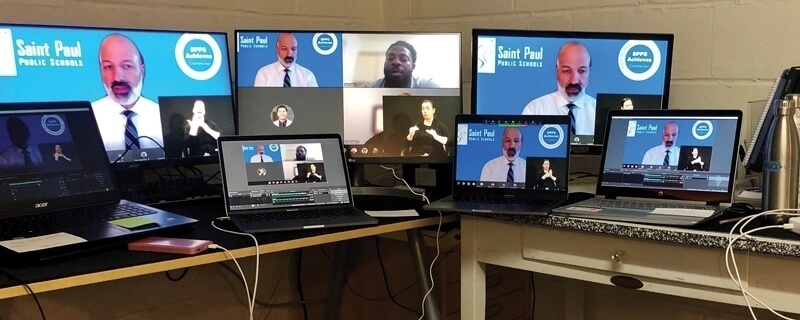
INGCO had to learn how to broadcast an event in four languages simultaneously.
Interpreting, most of which is done in person, shifted quickly. And, as it turned out, when the pandemic hit, many of her existing clients didn’t know anything about conducting meetings on Zoom or any of the other technologies that became vital to keep businesses running.
So, INGCO began teaching its existing clients for free, a decision not everyone agreed with but Christensen defended.
“We have to make sure we have business coming in the door and if that means we need to teach our clients how to do their work, then that’s what that means,” she says, adding that a lot of the technology work ensured some vital services were able to continue.
One of her clients, for example, provides mental health counseling for kids. “They had no idea how to begin providing services for their families and for their patients,” Christensen says. “Not only would we lose that book of business, but much greater than that, kids that desperately need this service wouldn’t have received it.”
For another client, INGCO had to learn how to broadcast an event in four languages simultaneously.
Word spread. Referrals came in. Sales spiked in comparison with 2019. She increased her staff from four to 10, including her son, Oscar Christensen, who regularly has the answers when tech-related questions arise. And, so far in 2021, the trend appears to be holding, as early Q1 was up nearly 50% over the same portion of 2020.
“Putting those things into place has allowed us to jump in and hold this space as subject matter experts,” she says. “The language piece, our core business, that’s the bare minimum now. We’re expected to be great at language services. We can’t not be. But it’s the other things we bring to the table that we are excellent at that make us different from the rest of the people in this industry.”
And many of these formerly in-person meetings are likely to remain virtual even as COVID clears, so technology training likely will stay a staple.
“Every day we learn more and every day there is a new technology. I really don’t think this is going to disappear. If anything, it’s going to grow more.”
Prepare early, pivot quickly
Diane Paterson, regional director for the Small Business Development Center in the Opus College of Business at the University of St. Thomas, says not all businesses lend themselves to such dramatic changes. Many of those that were nimble enough to react quickly, however, are in the best shape now. She works with a music school that, when in-person lessons became an issue, switched to online training that not only kept her business afloat but “grew enrollment dramatically,” due to the added convenience for parents of not having to drive children to appointments.
That was a switch of necessity in March, but one that will actually help the company expand long term, she adds. “She flexed quickly and it worked out well,” Paterson says.
Paterson also says businesses should begin preparing for down times during good times. It’s best practice, she says, to keep enough cash available to cover at least 90 days of expenses, preferably 180.
“If you are barely cash-flowing, you are not going to be prepared when the economy gets hit by outward forces,” she says. “I think you start planning for something like this before you launch your business. So, when you are thinking about starting a business you have to think in terms of ‘do I have enough money to do this?’ That’s just basic business planning strategy. You need to think beyond start-up costs. You need to have enough working capital to keep the business going no matter what happens.”
John Thwing, market president at 21st Century Bank, agrees that businesses need to plan ahead. Save some reserves for downturns. Analyze your cash flow. And don’t expect that a banker can help you out on an incredibly quick turnaround.
“What you don’t want is to go to your bank to solve a problem tomorrow,” he says. “You want to go to your bank to solve a problem that you see that is 30 to 60 days out. If you can’t make payroll tomorrow, it’s pretty hard for me to solve that. … You’ve got to give advisers and funding sources some time to address your needs.”
Seek help, but stand up for yourself
While few foresaw just how bad the COVID-19 pandemic would play out in the U.S., business experts say there are ways companies can put themselves in the best situations to survive massive downturns, whether they be related to pandemics, terrorism as happened on Sept. 11, 2001 or other difficult times. The beginning of a pandemic would not be the ideal time to try and start a banking or accounting or legal relationship. Thwing says the second quarter of last year was ridiculously busy as business owners – and lenders – tried to navigate the myriad of business relief scenarios.
“We were up to our eyeballs in PPP (Paycheck Protection Program) just playing defense trying to help people survive that first onslaught,” he says.
It’s also not a time to wait for your bankers or other advisers to call on you. Owners need to look out for their own well-being in situations like this.
“You’ve got a co-pilot, but you’re still the pilot,” he says. “You’ve got several co-pilots, including your lender, your accountant and your other advisers. But you’re still the one in the driver’s seat and you still have to do the flight plan. What I found is people who try to keep up and understand and ask questions and engage and, to some degree, push their agenda, they’re figuring stuff out more than people who are passive and wait for the banker to come to them. This is not a time to be passive.”
And stay alert, adds Thwing, who is known as “the SBA guy” for his focus on lending through the U.S. Small Business Administration. In early March 2021, the SBA came out with a new application for people who file Schedule C forms on their taxes.
“You’ve got to be light on your feet,” Thwing says. “With everything going on out there, you have to stay on top of what is available.”
Beyond that, focus on your balance sheet.
“The balance sheet is a pretty simple tool, but a lot of owners are afraid of it,” he says, pointing at cash, debt, equity and leverage. “Understanding the basics of the balance sheet can be really helpful.”
Communicate, operate, debrief
Don’t forget operations and communications, says Jon Austin, senior partner at J. Austin & Associates. A lot of companies were caught unprepared, he says, by the impact of the pandemic and they had to improvise, not always successfully.
“They were caught flat-footed,” he says.
One restaurant near where he lives closed initially, then re-opened, only to have to close again on two occasions due to outbreaks. “It took three times to get it right,” Austin says.
He suspects COVID will change emergency response and disaster planning going forward. There have always been, in recent years, sections in those plans on cyber breaches and workplace violence. Now they’ll include what to do if you can’t occupy your work space or what to do if you lose 90% of your revenues.
“For some that will be ‘we’re going to be out of business,’” Austin says. “For anything short of that, having a plan and having spent some time thinking through our range of options and what we can put in place ahead of time so we have the ability to implement quickly, I think that’s an advantage.”
On communications, he says he often gets calls at all hours from people who have something happen but don’t have a plan. That also warrants thought ahead of time, he adds. Finally, do a debrief. Half of the organizations he works with don’t, but they should.
“Some of it is they don’t want to spend the money,” he says. “Some of the people are traumatized by the experience and they don’t want to think about it anymore than they have to. But I think it’s a valuable lesson.”