Jay Sachetti joined Jeff O’Brien, partner at Husch Blackwell and Dyanne Ross-Hanson, president of Exit Planning Strategies talked about the market for mergers and acquisitions, exit planning opportunities for companies that don’t end up for sale and how companies can maximize their eventual sale price during an early October panel at the first Upsize on Tap event at Summit Brewing Co. in St. Paul.
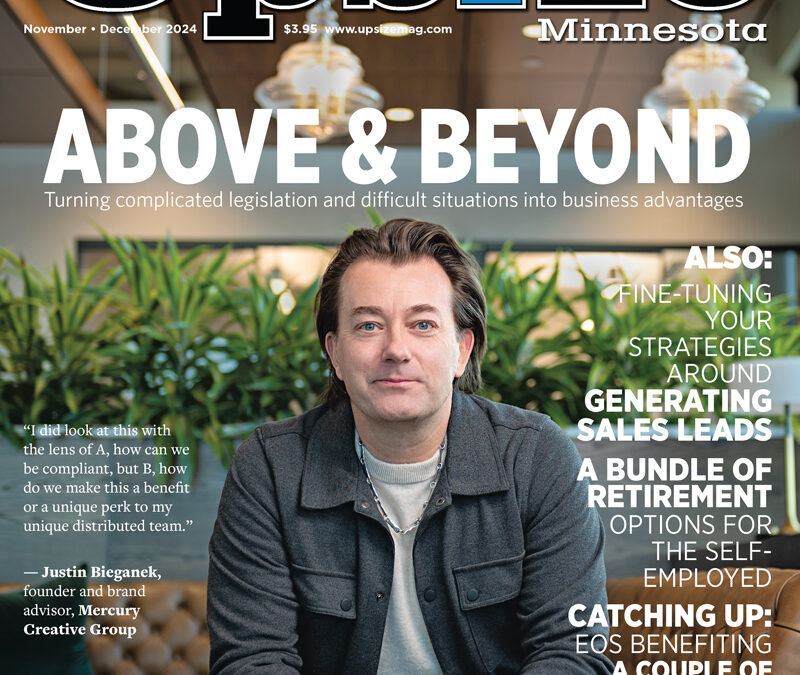
When the state Legislature passed a law requiring employers to provide paid leave and safe time for employees, Justin Bieganek started hearing differing details from friends, colleagues and peers.
“It’s so weird going from writing about business to running one,” said Robert Lillegard, a former journalist and marketer who now operates Duluth’s Best Bread with his older brother, Michael Lillegard. “You’ve got all those pieces on the floor and only three fit together. It looks so much easier in the box.”
I can relate, since I co-founded Upsize Minnesota in 2002 amid at the time a 20-year career as a business journalist. We made every mistake in the book while reporting on the best practices from the smartest entrepreneurs in town. It looks so much easier in an article.
Lillegard is running a crowd fund-raising campaign to purchase equipment to increase their bakery’s output, and to move into a much larger facility. “Here macaroons are our top seller. Our gal makes macaroons by hand. There’s a machine that will make the shells really fast, but it’s $30,000 and we already gave our profits to our staff,” he said.
They also need a new oven that costs $55,000, “more than my first house. And I can’t live in an oven,” Lillegard says. “We did buy the oven, but we haven’t paid for it yet. The bank owns the oven.” Reached in early December, the Lillegards had raised $8,000 from the crowd, on their way to the $55,000 goal.
The brothers’ titles are characteristically quirky. “We just say co-owner. You’ll laugh at this. We formed an LLC for the new property, and he’s the dean and I’m the royal vizier. ‘Royal vizier’ just seemed fitting somehow. ‘Dean’ is higher than me,” he says about Michael’s title. “He’s two-thirds, I’m one-third” in ownership.
“Michael’s a little bit of a savant; he has a master’s in maths,” said Lillegard. “He picked this job because he thought this would be a great story for our grandkids someday.” The younger Lillegard agrees, most of the time.
“I did want to change course, shortly before this expansion. When we were thinking about it, I started to get cold feet,” he said. “It’s been a wild enough ride. I think you gradually start to get to know the people who work for you and realize … it matters to them” and also to customers. “We’re the only people that do quite what we do. There would be a hole if we’re gone.”
Since starting in 2014 “from a card table at farmers’ markets, today we’re at 11 employees. About 100 people stop by in a given day and get about $17, $18 worth of stuff on average,” he said. “It’s French and German, so it’s crusty sourdough bread. It’s croissants and big fat German pretzels. Those are fun. We have a ridiculous logo, a big fat German guy.”
The Lillegards have recently begun operating using the “Great Game of Business” approach, an open-book management philosophy forged 30 years ago by workers trying to save their jobs when International Harvester was going down the tubes.
“So, we’re really open with the numbers. We tell our staff every month what our numbers are, what we spent, and what we made.” So far it seems promising, but then everything looks so much easier in a book.