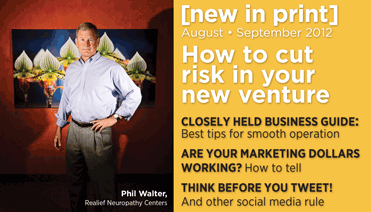
Leap of Research
When he finally limped into Dr. Timothy Kelm’s chiropractic clinic in St. Louis Park a couple of years ago, Alan Bignall was desperate.
Bignall had been to the renowned Mayo Clinic to treat his peripheral neuropathy, which was so painful all he could think about every day at the robotics company he runs was getting home to soak his feet. “He had a tough time walking a block to a business meeting,” recalls Kelm. But after several treatments, “he did very well.”
Kelm, a D.C. or doctor of chiropractic, had been working since 2005 to perfect the use of a Class IV therapeutic laser to treat neuropathy, a condition causing pain, numbness and balance problems. Kelm was simply treating one more patient when he helped Bignall.
But Bignall is CEO of Recon Robotics, which makes small robots used by the U.S. military to scout out dangerous locations, and he smelled a business opportunity. He recruited one of his board members, Phil Walter, as CEO. Bignall himself invested, and they formed Realief Neuropathy Centers, with the aim to roll out franchises throughout the country and build a national brand. Here’s Walter’s take on how he’s building it.
Upsize: Describe your company as it stands today.
Phil Walter: There are 50 million people in the U.S. that have peripheral neuropathy. It’s called the most common disease that no one talks about. It’s very easy to diagnose and get it right, but patients will get moved around the system like a merry-go-round. Every one of those stations knows there’s nothing they can do—there’s no cure.
The symptoms are pain—24/7. Numbness in the foot, that appears first, because that’s the longest nerve in your body. You notice you can’t feel the pad under your foot, then it flips to the other foot.
Upsize: What are the causes?
Walter: One-third is diabetes. Exposure to toxins or mechanical injury is a third. One third is idiopathic—we don’t know. Personally, I believe those are going to turn out to be toxins. It’s becoming more prevalent because of diabetes and the prevalence of toxins.
The nature of the disease as a symmetric disease is it starts on the left, jumps to the right, then progresses up the body together. It’s not unknown to get into your organ systems, and that leads to organ failure.
I’ve heard stories: one lady who came to our clinic couldn’t get out of her sunken living room. Patients’ lives are impacted tremendously by this disease. We have people in wheelchairs and taking opiates by the handful.
Upsize: So how does it get treated elsewhere?
Walter: Mayo will say, we can give you drugs out of the anti-depressant or anti-convulsant categories. A lot of people can’t tolerate it. Hypnosis is tried. The problem is, pain is very common but not everyone has pain. They might have balance problems. It used to be thought nerves were generalists, but now we know they’re specialized. A patient can have numbness and pain. If you look at the Mayo website, it will say try hypnosis, or acupuncture sometimes helps.
Upsize: Who else is using laser treatment?
Walter: There are other light solutions on the market, but it’s an LED. They wrap it around your leg and say it’s light therapy. But it’s not powerful. If you take a Class IV laser, as we use, the packets of light get through the surface of skin, and get 5 to 6 inches under that.
The definition of Class I, II or III laser is it won’t hurt your eye; it has 5 milowatts. We’re using 12 watts. Class III laser will give you a topical effect but it doesn’t do anything to repair the cell.
Upsize: So how does your laser work?
Walter: I talked to a neurologist early on, when I was doing due diligence. It was not known how aspirin works until very recently, but we don’t worry about it because the FDA asks about efficacy—does it work—and safety—does it hurt anybody. They never ask how does it work. We don’t know why it works. It is an unknown process.
I was in Cost Rica, and had an M.D. researcher there. She said nobody can be authoritative on this.
Upsize: How did you get involved as CEO?
Walter: Two years ago Alan Bignall called me. I’m an investor and I’m on his board, for Recon Robotics. He called me and said, I had peripheral neuropathy and I’m cured. He said, I want you to meet Dr. Tim Kelm, the chiropractor who had developed the treatment.
Alan told me that he had neuropathy for quite some time and had been treated at Mayo. Two years earlier he had gotten Dr. Tim Kelm’s literature. He thought, it’s snake oil. It’s chiropracty. I’m at Mayo. But he was desperate. He had 24/7 pain. He went to Dr. Kelm. He started into treatment, and lo and behold he had finished his treatments and he was symptom free. He called me and said, it has to be a business.
I’m in the TCA group, Twin Cities Angels, and I got the board seat at Recon Robotics probably in 2007.
Upsize: What made you decide to invest in Realief?
Walter: Two years ago, I did six months of reading and talking and investigating. I looked at: is there a need not being met? Why is it not being met? How might it be met? Who are the competitors? So you do an assessment and the profile that came out was 1, it’s not being met because it’s not understood, and 2, the origins of the disease are complex.
So, even the case of some of the drugs that are used, those things work by changing the perception of the pain. All the people investigating this area are small, one of a kind doctors or chiropractors. Nobody with deep pockets has a strategic interest in developing it. Coincident with this, in 2003, was the FDA clearance for Class IV therapeutic lasers. It had been in use for vets. Now you can treat humans.
There’s nobody with a business model and a footprint. There were bit players, individuals. The playing field was wide open.
Upsize: How did you condense these different pieces of information to make your decision?
Walter: I knew we have to be in a business where we can build a brand. I looked at Lasik. I wanted to find a reason that this will fail. I have dissected every aspect. It’s just my cumulative 35 years of business experience.
I used to work for the president of a Fortune 500 company. He introduced me as a risk taker. I had to correct him. I said, I don’t take risks. I only do it because I know what to do. I used to drive race cars. I used to jump out of airplanes. But I don’t take risks. I’m risk-averse. The way you avoid risk is you learn how it all works.
So I thought, I must be able to drive a consumer business, and in a consumer business you need a brand. There’s no Lasik in this field. There’s no McDonald’s vs. Burger King.
The first decision is, can we get proprietary technology? With light therapy you can, but our system is much bigger than that. All calls go to our Plymouth office, and they trigger on a scheduled basis our marketing. At some point patients are going to give up and say, Help me. When they say yes, we’ll transfer them and then the clinic takes over. Right now we have this clinic, in St. Louis Park, and one in Tucson.
Upsize: You mentioned Alan Bignall didn’t believe the literature at first, because it came from a chiropractor. Chiropractors seem often to be almost defensive about what they do.
Walter: They all have emotional distress over being a chiropractor, because they’re not credible and they lose social status. They want to get away from chiropractic. So chiropractors have incentives to change their practice from chiropractic to something else. We determined we would be evidence-based, and that addresses a lot of those concerns. The options were licensing or franchising.
Upsize: Why did you choose franchising?
Walter: You want to build speed bumps. We built that software, and the laser is tethered to our software. Branding is everything,, and the way McDonald’s built their brand is the hamburger is the same in Miami or Detroit. As a franchisor we can control that. So franchising made sense.
Upsize: There are additional regulations in health care, correct? Beyond what franchisors in other industries face?
Walter: We run into HIPPA, the privacy laws. Stark laws, the anti-kickback laws. The FDA, Food & Drug Administration. Franchise law. You run into so many things, but it doesn’t surprise me. You just have to smile and say, it’s not a simple crossword puzzle. It’s a three-dimensional maze. But that’s what makes it interesting, and you have to be very creative.
It’s good for us because I’m a smart guy. And I know people who are getting into all these problems. I see them making amateur mistakes. To do business, you have to stay in bounds.
Upsize: How are you going about selecting your franchisees?
Walter: We vet a prospective franchisee very carefully. We visit. We do background checks. I want to know everything about them. We want to sign only enough in any given market that those two or three can succeed. We’re going to invest in that market at first. That is the only way to do franchising. If somebody fails you will have a 10 times harder time selling the next one.
When we start in one market with one laser, we’re going to be losing money. It’s a pacing issue. Our first franchisee, in Tucson, is a smaller territory. It costs $35,000 to $50,000 to start, on up to $150,000. The equipment could be leased.
Upsize: How are you going about this rollout?
Walter: I was a philosophy major in college. I had a professor who said, If your challenge is to get to the moon, you’re going to climb a tree, then a Redwood, then a skyscraper. Eventually you’ll realize you have to build a rocket ship. All the competitors you see are climbing taller trees.
We’ve raised $2 million from angel investors. We’ve hired a VP of sales who came out of St. Jude Medical. We’re looking at cities; we’ll go where population is big but the media spend is low. We want to sign five franchisees this year; we’ll have 200 franchisees in five years.
DaVita is another model, the kidney dialysis company. We’ll follow their path. Then we’ll go through the FDA and get labeled for neuropathy Then we’ll go to Kaiser, United Health Group, other insurers, and say, you can outsource your neuropathy treatments to us, like DaVita does with dialysis.
Upsize: Tell me about your proprietary software.
Walter: Our software is our proprietary system. Every treatment for every patient is unique here. The algorithms will grab all your information and modify your treatment. We worked on it for two years.
Dr. Tim Kelm, he proved the concept that we could do this. We’d study him and watch him. We had to get the nuances that were in his brain and put that into the algorithm.
Upsize: What did you do before this that you applied here?
Walter: At Michelin, I ran a business that was all high performance and motor sports. I went to my boss and said, you put me in charge so you have to send me to race-driving school. So he wrote a check for $2,000 and I went to driving school. I kept on going, and eventually I went to 27 schools.
Upsize: How much do you want to determine what causes neuropathy?
Walter: For the business it’s not critical. But I’m curious. I want to know. Some day we’ll find that out. Once that laser works, we’ll allow that doctor to treat other pain conditions. MS has come up. It’s an autoimmune condition. If the issue is a matter of the pace of damage, what if we see that this can slow down the damage? That’s probably a whole other business. We may apply for a grant, and get a test through the National Institutes of Health. That’s down the road, though. If my theory is right that this is a method to accelerate the healing process—there are many possibilities.
Upsize: What keeps you up at night?
Walter: Timing. Starting a business always takes twice as much time and twice as much money as you thought.