Jay Sachetti joined Jeff O’Brien, partner at Husch Blackwell and Dyanne Ross-Hanson, president of Exit Planning Strategies talked about the market for mergers and acquisitions, exit planning opportunities for companies that don’t end up for sale and how companies can maximize their eventual sale price during an early October panel at the first Upsize on Tap event at Summit Brewing Co. in St. Paul.
When the state Legislature passed a law requiring employers to provide paid leave and safe time for employees, Justin Bieganek started hearing differing details from friends, colleagues and peers.
While encouraging signs are starting to glimmer on the economic horizon, it’s still important to reduce and manage financial risks during these relatively uncertain times.
Many companies are doing this by breaking new initiatives into smaller projects and funding them one at a time, versus committing to a major project up front. This prudent approach increases managerial flexibility and limits upfront financial commitments.
Technology investments are rightfully coming under this type of scrutiny. Savvy managers are devising new ways to keep technology investments from putting a cash-crunched company at financial risk. The following examples of strategic thinking and careful use of staffing resources, creative approaches to managing costs, and strong management and communications, all offer lessons on how to keep IT projects on track without breaking the bank.
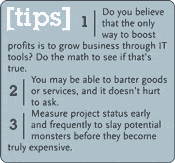
Lesson 1: Pick your battles Tight budgets and waning profits make prioritizing technology projects crucial. When setting priorities, many technology managers falsely assume the only way to bolster weak profits is to grow the business through new IT tools. A simple strategic analysis can prove otherwise. Consider the following exercise I use with my students at the University of St. Thomas Graduate School of Business Management Center.
Company A is a $10 million company with an 8 percent net profit. Its executives have to choose to (a) fund a system that increases sales by 30 percent or (b) a system that reduces costs by 6 percent.
Then we work through the various scenarios:
A 30 percent increase in sales generates an additional $3 million of sales and profit of $240,000.
A 6 percent decrease in costs creates an additional $552,000 in profit..
This is a simple problem, yet it illustrates the factor of difference between basing ROI, or return on investment, on an initiative that promises to help us “grow out of our current problems” by increasing sales and a system that removes costs by integrating, streamlining or removing work. As a company’s profit margins go down, as many have in current times, cost reductions frequently win over sales increases.
The technology implications of this principle are obvious: now is not the time to invest in major new IT initiatives, such as building a new Web site to reach new markets. Instead, focus on applications that can help you squeeze more productivity out of existing systems.
Lesson 2: Use staffing carefully If more staffing is needed to build a technology system but you aren’t in a position to hire additional full-time employees, consider using supplemental staffing consultants in a way that reduces your cost exposure. If the project has longer-term opportunity than is known at the current time — or you believe the project will be longer-term but can give an unconditional guarantee of a minimum number of project hours — negotiate a lower rate based on the best-case long-term scenario.
To cover the vendor, add a “snap-back” rate in the contract that will apply the non-discounted hourly rate to all the hours worked if the project is cut short due to economic or other conditions beyond the vendor’s control. This approach is a win-win because you receive lower rates for bigger projects and the vendor makes a fair profit in either scenario. It’s also less demoralizing to existing staff if you need to abruptly end a vendor contract with a supplemental staffing firm due to shifting economic pressures or sudden downturns in your business. After all, no one expects vendors to be a permanent part of your staff.
Another standard approach to handle extra work if you don’t have the ability to hire IT staff is to simply outsource the project. When outsourcing a development effort, share risk by paying on deliverables. Paying on deliverables is similar to how a bank releases funds when a construction company is building a house. With each passing milestone, after verification it has been met, a payment is made.
Milestone payments work best if you are concerned that a vendor’s offer may be too good to be true. In this situation, it’s important to agree on a list of “acceptance criteria” for each deliverable before work starts on the project. This ensures that both sides have a clear understanding of the word “finished” for each deliverable. It also means you’re not obligated to pay if the vendor is guilty of willful negligence or fraud.
Lesson 3: Barter to lower cost With thought and creativity, bartering can result in significant savings. For example, technology training classes offered by Intertech, our training company for enterprise developers, have a value of $2,195 per student, per five-day class. The value to our customer is $2,195 but our cost is much less for a class we have already agreed to hold — much like an airplane flight with a pre-set number of seats.
In some of our dealings we have been able to trade certificates as in-kind payments for products or services we receive from other companies. We ask the certificate recipient to attend a class that we’ve previously agreed to hold, which has unused capacity.
In addition to bartering, explore other opportunities to receive technology-related services for a lower investment. Can the work be condensed or stretched over a period of time? Is there value for providing introductions to other areas of your firm for your vendor?
Lesson 4: Over-communicate and measure Measuring project status and regularly communicating with IT staff provides objective indicators of project health and keeps costs from escalating due to mistakes or false assumptions. Sampling early and frequently slays potential monsters before they get a chance to grow up.
In the final analysis, IT projects can and should continue, even when times are tough. Strategic thinking and careful use of staffing resources, creative approaches to managing costs and strong management all must work together to keep your IT projects going forward.