Jay Sachetti joined Jeff O’Brien, partner at Husch Blackwell and Dyanne Ross-Hanson, president of Exit Planning Strategies talked about the market for mergers and acquisitions, exit planning opportunities for companies that don’t end up for sale and how companies can maximize their eventual sale price during an early October panel at the first Upsize on Tap event at Summit Brewing Co. in St. Paul.
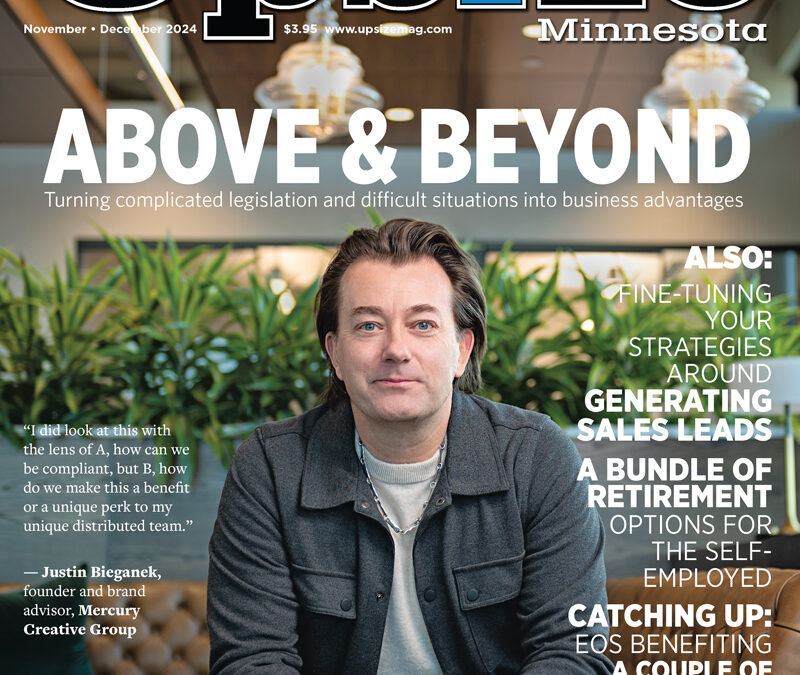
When the state Legislature passed a law requiring employers to provide paid leave and safe time for employees, Justin Bieganek started hearing differing details from friends, colleagues and peers.
1, Name your fear. Articulate what you are afraid of and then ask yourself “then what?”
2, While adverse outcomes are a possibility, we often let our fears outweigh the likely consequences of a decision.
3, Grounding your thinking in your company values can help make the case for a risk and settle some fears around the decision.
4, Assess what you can learn from the risk you are taking. Perhaps even if you don’t get the result you are seeking, taking the risk will provide information of value anyway.
Related Article
Taking risks when you’re scared
Risks are a necessary part of business, yet most of us find them hard to take. We hem and haw, try to collect endless data to substantiate our decisions or just put off decisions altogether. Neither our fear of risks nor the need to take them will likely go away anytime soon, so perhaps the best path forward is learning to take risks even when you’re scared.
As a small business owner myself, I’ve made tough calls. I’ve had to jump into new ventures with some unknowns and I’ve had to cut some opportunities short that seemed right but turned out not to be best. I’ve had to fire clients and say no to engagements that didn’t align with our values. These were all risks, some more calculated than others, but risks nonetheless. From these experiences, I’ve noticed that I can more easily take risks, even with some fear, if I follow a handful of accessible practices.
What’s the downside?
Name your fear. Articulate what you’re afraid of and then add, “Then what?” For example, “I’m afraid it will be a waste of money.” Then what will happen? Will you go bankrupt or have you hedged your bets enough to sustain the loss?
Often our fear of something far exceeds the likely consequences. Of course, there may be adverse outcomes, and stakes are always at play. But if you’ve calculated your risk to some degree, the sky won’t fall. Help your brain and emotions remember that by walking through the specific aspects of your fear and potential outcomes.
Let your values guide you. I find that grounding my thinking and decisions in our company values helps me both make the case for a risk and settle some of my fears around it. Connecting a risk to your values shows how aligned the risk is with who you are as a company. If you can’t see the value of the risk within any of your values, it might not be the right path. But if you see how the risk lines up with the actions and behaviors driven by your values, it can start to feel much less scary.
When you show the throughline to your values, you can demonstrate to others that the decision isn’t random, even if it’s risky.
Upsides despite failure
Assess what you can learn from the risk you’re taking. There is powerful value in seeing the upside of things, yet “believe things will work out” isn’t great practical advice (even though it is good). So, rather than try to put on rose-colored glasses, I look for value in the situation even if things don’t work out. Perhaps the outcome of what you do won’t precisely be what you want or expect, but what data will it give you? Incremental learning is crucial and valuable in a small business operation.
If you offer a new product that doesn’t take off, you have learned what customers don’t want. If you raise prices on various services and clients protest, you have learned where your current price ceiling is. These sound like lessons you don’t really want to learn, but that doesn’t mean you aren’t learning something valuable.
Identify what you may miss out on by not taking the risk. In business, inaction can have as many negative consequences as poorly thought-out actions, but we often don’t take stock of them because they’re difficult to identify. If you don’t take a particular risk, will you lag behind your competitors? If so, what is the risk of that?
By doing this calculation, you start to understand the opportunities lost. This thinking can help you understand the risk of not taking the risk (a bit meta, I know).
Seeking outside guidance
Walk a trusted colleague or team through your reasoning (everything above). Pausing to share details about your thought process can help you determine if you missed something and see what you got right about the risk. Outline the risk you’re taking, why you’re nervous, why you’re taking it, what you can gain or learn from doing so and what you may miss if you don’t take it. See if going through your thoughtful steps changes your mind about any aspect of the risk and ask your audience for their perspective. You’d be amazed at what we miss when our thinking is clouded by the emotions fear can bring up.
I don’t think our fear is going anywhere. Veteran business owners still feel it. We can’t be fearless, but we can fear less. By taking these steps, you start to see the risk with more dimension and objectivity, combatting the all-or-nothing thinking and subjectivity that fear can bring.