Jay Sachetti joined Jeff O’Brien, partner at Husch Blackwell and Dyanne Ross-Hanson, president of Exit Planning Strategies talked about the market for mergers and acquisitions, exit planning opportunities for companies that don’t end up for sale and how companies can maximize their eventual sale price during an early October panel at the first Upsize on Tap event at Summit Brewing Co. in St. Paul.
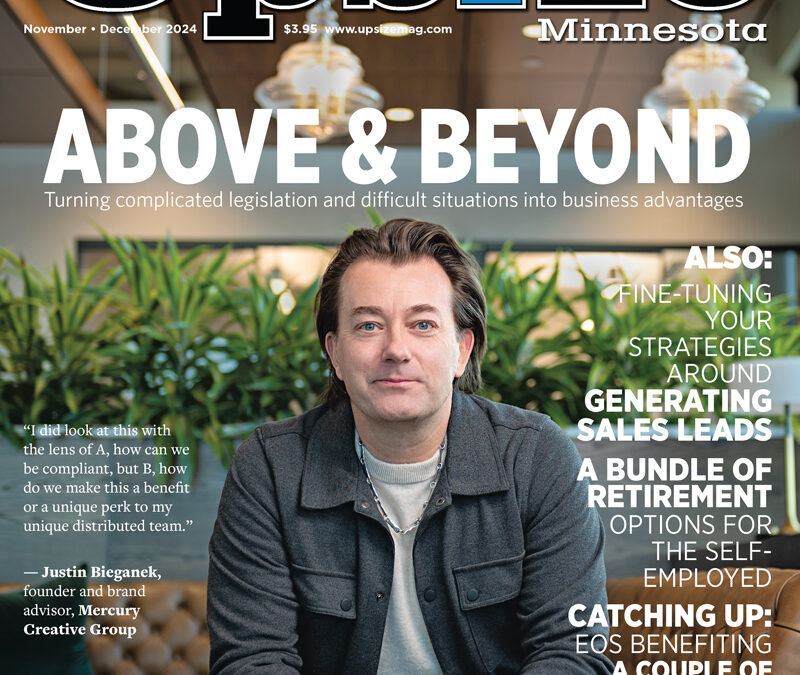
When the state Legislature passed a law requiring employers to provide paid leave and safe time for employees, Justin Bieganek started hearing differing details from friends, colleagues and peers.
1, Keep stretching yourself by doing new and different things, such as going on adventures, reading multiple perspectives and challenging your current approach.
2, Whether it’s giving back to the community or something else, figure out what gives you purpose.
3, Begin planning now what retirement might look like. Everything you do is an input to your plans. There’s no need to finalize them now but keep it in mind as you accumulate experiences.
4, Get curious and get to know people. Evidence suggests creating new connections is well worth it for our long-term well-being.
When you think of the word retirement, what comes to mind? For many it’s 401k planning, travel, new hobbies, giving back, more golf, family time and being untethered to the hustle of what has been. As we think of our own retirement, it can also be uncertain, uncharted territory. The closer we get, the more trepidation it can cause.
Use the word retirement in front of a group of individuals who are approaching it, are in it or have successfully made the transition and, for most, they’ll tell you they dislike the word. Or rather, prefer a different label. At least that was what 12 successful professionals expressed when invited to our offices in January for a discussion on retiring with purpose.
Over our careers, we’ve worked to build our resumes by saying yes to opportunities, networking at events and experiencing professional development to grow our skill set. We’ve done this all in the hopes to achieve, make a difference, demonstrate our worth. So, it’s not surprising that after we’ve spent much of our lives in pursuit of the next great thing, that when it comes time to slow down the career train, we’re anxious and want to avoid the screeching halt. Turns out we don’t have to be nervous (Okay, you can be a little nervous!) if we allow purpose to be present in negotiating the transition.
Charles (Chuck) Squires, who’s retired from Robert Half (fully now!) shared an early draft of his presentation, “Stretching in Retirement with Purpose.” Through his storytelling we learned about paper routes, interviewing Jackie Robinson, his faith, schooling at the University of Minnesota, his service in Vietnam and his dedication to lifelong learning. These experiences have led him to three important themes he discovered over his retirement years: how to stretch, find purpose and connect.
Stretch — Keep doing new and different things by going on adventures, reading multiple perspectives, and challenging your current approach. Chuck’s perspective reminds us of one of our favorite Prouty Project quotes by Oliver Wendell Holmes, “A mind stretched by a new experience can never go back to its old dimension.”
Purpose — Know what drives you. For Chuck, it’s giving back to others in his field and in his community. I love the quote he shared with us that day, “You can be the world to someone by doing something for the world.”
Connect — Get curious, get to know other people and treat them with respect. Wherever you maintain and create new connections, evidence suggests it’s well worth it for our long-term well-being. Through mentoring and his faith-based community, Chuck has continued building his intentional network.
As Chuck shared his memories and learning, the group listened, smiled and nodded. It was clear they were in sync. And for each person, this is an individual exploration.
Jitesh (JR) Mehta, from JRM Consulting, shared this reflection about retirement: “I was afraid to be idle the entire day with no accomplishments to look back on, nothing to engage my intellectual mind with and no real drivers in my retired life. It seemed like I would have no purpose in life even though I was surrounded by grandkids, hobbies, a cabin to hang out at, friends to share drinks and evenings and games with, etc.”
Even with these connections, JR was still missing purpose and fulfillment in what he calls ACT II. “Thus, here I am in ACT III of my life … engaged, contributing to the field I have spent the past 45 years working in. I am happy, busy and feel fulfilled.”
For me, as a 45-year-old in the middle of my career, retirement has always been about my 401k, financially planning for the life I think is in store for me when I retire. So, as I sat around the table as the youngest person in the room listening to the careers of these accomplished professionals, I realized there’s no need to delay thinking about how to retire with purpose. The time is now. The blueprint is right in front of us. The good news? All the work we’ve done and will do are inputs to our retirement plans. It’s what you’ve already been preparing for. Who and how do you want to be in retirement? Work it backward. Work it forward. Just work it out.
We encourage you to consider what your strategy for retirement can look like or if you prefer, the next phase of your life. And as Chuck would say, “don’t forget about the drivers that will help you retire with purpose.” Turns out, all the skills you’ve built to stretch your limits, find meaningful opportunities and build relationships, will be very handy (and needed) in life’s next adventure.
Resources shared by group:
“Portfolio Life: The New Path to Work, Purpose, and Passion After 50” by David Corbett
“Necessary Endings,” by Dr. Henry Cloud
“What do you Want to be When You Grow Old?” by Richard Leider and David Shapiro
“From Strength to Strength: Finding Success, Happiness, and Deep Purpose in the Second Half of Life,”
by Arthur C. Brooks
“The 3 Phases of Making a Major Life Change,” by Herminia Ibarra
“The 4 Phases of Retirement,”
by Dr. Riley Moynes TED TALK
Liberation (vacation)
Disappointment (loss and lost)
Experimentation (how can I make my life meaningful again?)