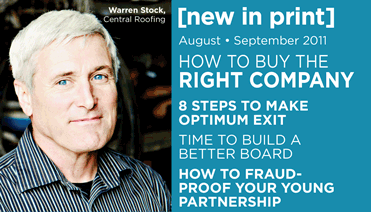
Warren Stock,
Central Roofing:
763.572.0660
ws****@************ng.com
www.centralroofing.com
Steve McFarland,
MindShift Midwest:
651.767.3321
sj*********@****ts.net
www.mindshift.com
by Beth Ewen
ABOUT THE COVER STORY
When Upsize began preparing articles about how to buy or sell a company, we sought business owners who had recently done either or both. Two interviews stood out, which we present here: Buyer Warren Stock, who years ago sold his roofing company when his son wasn’t interested in joining the family business, stayed on as president for an uncomfortable time, then decided last year to buy Central Roofing Co. from the same corporate parent that now wanted to shed assets. Seller Steve McFarland, who built technology consulting firm Orbit Systems from scratch with two partners, diligently kept in touch with industry contacts who expressed interest in buying him out along the way, and circled back to new owner MindShift Technologies when his partners wanted out but he planned to stay in the game with less financial risk. They describe the smart ways to buy or sell a company and the mistakes to avoid. Following the interviews is our guide to small-business m&a, featuring advice from accountants, attorneys and bankers.
Upsize: Describe Central Roofing Co. as it stands today.
Warren Stock: It’s a commercial roofing company. Revenues around $14 million. They do commercial roofing, sheet metal, and a little bit of service. There are 70 employees. Most of what they do today is working with new construction, general contractors, and then what we call public bids: re-roofing for schools and that type of thing. It was founded in 1929.
Upsize: Why did you buy it?
Stock: I bought it because I started a roofing company in the past, and I sold it to a company, and I wanted to get back to the entrepreneur role again. When I sold my company in a corporate rollup or consolidation, we were able to run it as we had in the past. As things changed, so did the roles and input and direction, and so I needed to get back out into my own business. I sold it in 2003, and I stayed as president. I actually purchased this company from the company I sold the company to: Tecta America, a large national roofer.
Tecta had grown and changed and got away from the local control to more a corporate control through the past years. That had progressed and I showed some concern. In the meantime because of the recession, Tecta, which has companies all over the country and all over Minnesota, had started to contract. This was a company they wanted to close or sell.
Upsize: How long did the process take?
Stock: It started last fall. I had a buyout clause in my contract where I could leave for a year with a noncompete. My son had been working at the company for a couple of years, and the idea was he would take my spot and I would move on. That wasn’t their idea. I heard that they were going to close down Central Roofing, and I asked, Would you sell it? And they said they’d think about it, and they wanted to move quick. They said, can you get the financing together in 20 days?
Upsize: 20 days! What did you do?
Stock: My instinct is if I see an opportunity, the words come out of my mouth: Well sure, I can do it. Sure, I can come up with that much money in 20 days. And then I went gulp and I had the thought processes of how to get the money. And it came together in 19 days, but then I don’t think that they were ready.
The banks weren’t all that excited. I approached getting the money from two different perspectives: A, people who wanted to invest in it and would take portions of it. And then B, I heard about Orion Capital, out of Bloomington, that they could put a package together. We went through the whole financial process, and we put together a budget, past experience, how we could make this profitable. They made it into a package, boxed it up, and they found two banks that were interested. We actually had to choose between two.
We went with Alerus, $1.5 million down in cash, and then there are receivables to buy out. Basically the company’s worth $3 million, and so we pay $1.5 million up front and as receivables come in, they’re past receivables, we turn them in to the bank.
Upsize: Are you glad you didn’t have to bring in other equity partners?
Stock: Very pleased. I feel the game plan that we have is going to work very well. My son invested some of his cash. But that was the whole idea of coming back into the entrepreneur’s world is not to have big brothers. Partners are big brothers too.
Upsize: Who did you rely on as advisers?
Stock: I had a fellow who was retired that worked for me. He was 72 years old and he had worked for the Carlson Cos. for 40 years. He actually did about 200 of their acquisitions. He was one of those guys you could go to, and say, What do you think? That’s always been my thing: If I’m going to do something I find people who know how to do it and ask them. He was a huge resource for not so much where to go, but what the process would be.
I put together what I call an acquisition team. I have a good acquisition lawyer, a CPA we put into the process, and then the financial guys. Alerus was a terrific bank to deal with.
We had the basic six-paragraph agreement in 20 days. They wanted to jump past the agreement and go straight to a purchase agreement, but we didn’t get a purchase agreement that quickly where everybody was comfortable.
There were a lot of players in on their side, so there were a lot of players to get through. Tecta was owned by another corporation, too. We didn’t get a purchase agreement done until 4:30 New Year’s Eve. They definitely wanted to unload a roofing company in the winter, and I just wanted to get the deal done. The hardest part is if you buy a company from another individual, you’re just dealing with that individual. If you buy it from many players, the process gets slowed.
Upsize: So how did you make it happen, with all those players?
Stock: Persistence. I tried to keep the schedule going, whatever the stumbling block. Whether it was how to evaluate the assets, how to take care of the inventory-I just kept the process going. If they had a concern I looked into how we could fix it.
It was more important for me to get it done than for them to get it done. They wanted to close this company or sell it, but my motivation was, let’s get it done.
Upsize: What advice did you get from your attorneys?
Stock: With the lawyers it was obviously the process, the key things that we wanted to get out of the deal. So you list your priorities, whether it be financing, how much cash, assets, receivables, employees. And then what you’re willing to give back.
The price was one of the concerns but the price doesn’t always drive the deal. I worked for Tecta, and so one of their concerns was that I wouldn’t just take all their employees. There were some no-hire agreements, and then we discussed who shouldn’t be on that list, how long a list, what that pertains to as far as if you’re fired or laid off. That was one of the key concerns of theirs.
How that concern came to me first and how it evolved I guess was complex. It started out really simple. It got really complicated, and then we got it back to being simple.
Upsize: How did you get it back to simple?
Stock: By keeping to my objectives. I knew the employees better than they knew the employees. So basically I gave up a big list of people that I had no intention of hiring anyway, and got the key people that I wanted.
Actually I started out at Central Roofing as an apprentice when I was 18 years old. I worked there 14 years. The owner died of a heart attack. A new son-in-law came, and I left. I had a side business in residential roofing. When the new owner came I decided to do that fulltime. So the evolution is, I’m back where I started.
Upsize: Which is easier, buying a company or selling a company?
Stock: Buying is 10 times easier than building.
Upsize: But what about selling?
Stock: Selling, it was difficult personally. Your company-they’re almost like children. You nurture them along. You take them to these levels and then you have to trust someone else to take care of them for you. That was probably what the whole problem was. I didn’t think they were taking care of them as well as they should. Selling is more difficult emotionally.
Buying is difficult because you’re going to come in as the new guy. You have a short time to build relationships. The first weeks are critical. We closed on February 28. I did come in early and did the due diligence. That’s when you start to build those relationships. You come in with the game plan, and you have to change things.
Most people want to know, what’s the plan, and I didn’t really disclose that. I didn’t let out any information because whatever you say can be misconstrued.
Upsize: So now that you have the company, what are you doing with it?
Stock: We’re trying to change not the type of work but how they get work here. They’ve been coming up with being dependent on a public market. We’re trying to change that to a sales company or a customer service company. In my past company, one of the biggest ways we had growth was through a service department. It’s kind of new for our industry. We built a whole department that did repairs and inspections. We brought that here, and that builds relationships, rather than having to go back to what I call the trough.
I was able to bring along my service manager, who built that for me in the old company. When I came here they had two trucks for service. Now we have eight. That’s probably the part that the banker understood the most, because of the margins in service and in the development of the customers.
Our profitability has already improved, up 20 percent from the same time last year. An example of this is last year at this time they had done something like 27 service tickets, and last month we did 317. The service department is the key.
Upsize: Are you hiring people?
Stock: We’re changing as a customer service oriented company, but I’m trying to bring as many people as we can from inside, at least give everybody a try. We might have to hire from outside later.
Upsize: Are you changing anything in the types of business you’re going after?
Stock: We did a lot of “green” roofs at the old company, and that’s another one of those roles that we’re trying to set up and pursue. I did the Target Center at my other company, two years ago. That was a fun job and one of the reasons I took it was it showed that you could put a green roof on any building. There was always the idea that a green roof was too heavy. It has a lot of water on it. And the Target Center roof is just a big dome with nothing in the middle, so if you can do it there you can do it anywhere.
Upsize: Describe that Target Center roof.
Stock: Two years ago, it got a re-roof, a green roof, 2.5 acres. You have your roof, then we put down what we call a root barrier and some type of irrigation, and a kind of soil, and plants are put on there that are drought and water tolerant. What happens is it rains, the water is held on the roof, the plants feed off of it, and it A, keeps the stormwater on the roof so it doesn’t go down the drain. And, B, if you go on a rooftop in the summer the temperature is 160, and on a green roof it’s 80.
Upsize: What will your company look like in five years?
Stock: I’m hoping our company will be known for our customer service and customer relations. My goal is not to be the biggest roofing company in the Cities. There is a sweet spot that I’ve learned, about the size of the company vs. the market. We’re planning to do acquisitions in the future in other markets.
Upsize: How will you finance those purchases?
Stock: We’re OK with the cash. We’ll take a look later this fall, in Rochester. I have a great partner, Jason, my son. How this all came about was Jason went to college and he didn’t want to go into the family business, so that’s why we sold it. After he went to college and he went into accounting and business, he changed his mind and we were already sold.
Upsize: What’s it like working with your son?
Stock: I love it. I have a great son and we do lots of things together, from drag racing and so on. We really work together good. He’s like his mother, very conservative, and I’m not. He takes care of HR, safety and the administration. I take care of production, service and sales.
Upsize: What’s one lesson you’ve learned, about being an entrepreneur?
Stock: Keep your eyes open, because opportunities are everywhere.
Founder started early, never said no to
sell Orbit Systems
Upsize: Describe Orbit Systems as it stands today, now part of MindShift Technologies Inc.
Steve McFarland: Orbit Systems is largely intact as MindShift Midwest, so we are the Midwest regional office for MindShift. Very little has changed. My partner Phil Palmquist has exited the business. We had been planning for some time for his slow ramping out of the business.
He expressed an interest to me on cutting back on his hours and time, specifically on the day-to-day responsibilities. We had started down the path. We had taken his role and split it into two distinct jobs. We brought people within the organization and brought them into those roles. That was about a year before the acquisitions.
Phil was a partner since the beginning, since 1999. There were three partners in the business; Phil, myself, and then we had a silent partner. There was a discussion about exiting, and we started talking about it as partnership, and the silent partner wanted to exit as well. I’m a good 10 years younger than both of them, and I was not ready to exit.
Upsize: How did you find your buyer?
McFarland: Over the last two years we had been approached by several different companies that were interested in doing something with us, and we had no interest. One thing I would tell all business owners is never say no until you see what’s on the table. We took the time to hear what those buyers had to say, whether it was a strategic buy, a financial buy.
Over those couple of years I had a very good sense of what the market was, what people were willing to pay. I had a really good sense of strategic buyers vs. financial buyers. I had a really good sense of how they attributed value to an organization, what the equations were. And I had a pretty good idea of what we were worth and what our options were.
That’s something I would recommend to any business owner that thinks they want to exit their company any time in the next 10 years. It’s not a waste of time to have those conversations. If you want to really become educated on what your company is worth and how they value you, those are all really good.
Upsize: Did these potential buyers all value your company the same way?
McFarland: No, it was incredibly varied. I talked to some equity companies that were doing rollups, and they had even picked up companies that were similar to us in the marketplace in this geography. All their thing was, they were rolling up, they were gutting companies, trying to drive revenue, trying to drive earnings, and ultimately an equity group wants an exit, and a very short-term horizon. In that case you’re looking at something that’s going to destroy your organization in the not too distant future. They’re going to turn it and sell it again, and it’s like a machine. I was not interested in that at all. I wasn’t looking for an exit that would take me out, or that would damage our organization. I was interested in protecting our customers and employees.
On the other end of the spectrum you have people who are growing their own business, because they want market share, they want to be a dominant player, they’re working for companies that can differentiate in the market, and it’s a very strategic acquisition. And in between you have all kinds of things going on. I talked to a company that did an acquisition here in the Twin Cities, and it had been a failure, and they were looking to fix that.
Upsize: How many prospective buyers did you talk to?
McFarland: I would say we talked with six or seven different groups over a two-year period. They ranged from sole proprietors to equity groups to companies that had a variety of ownership.
Upsize: Was one of them MindShift?
McFarland: No. About four years prior to the acquisition MindShift had approached us, and it was again we weren’t interested, but it was a conversation we were willing to have with them. We exchanged a lot of information at the time. Because they weren’t competing in our market (they’re an East Coast company) we felt comfortable entering into a relationship with them where we freely exchanged information. It’s pretty common in our industry that companies have these relationships. It was primarily myself and the market development person.
Upsize: When did it start becoming serious?
McFarland: I started to look at how I could create an exit plan for my two partners. We talked to a couple of brokers, people who would put your business up to the market. And I looked at the potential to finance the exits myself, and become a sole proprietor. It’s a lot of money; it would have taken a lot of cash. All people who own businesses know what it’s like to have your house on the line and sweating out the payroll, and I had already been through that. For me to create an exit on my own for my other two partners, I would have been looking at another 10 to 20 years of that.
Then you look at taking it to market, and I thought, I’m going to call the guy at MindShift and see what they’re up to. I called him, and said, Hey what do you think. And they said they were still looking to expand in the Midwest and hadn’t found a good acquisition target, and if we were serious about it they would be happy to sit down with us. That started a conversation that pretty quickly led to an offer, and we went back and forth on that and we negotiated, and worked out something that we thought was very good for us and we believe it to be very good for MindShift. I ended up converting some of my equity over to MindShift equity.
Upsize: Is that a good thing?
McFarland: I think that’s a great thing. First of all Mindshift is on a very good track similar to what we were on. MindShift is in lockstep with me with where we want to go and how we want to get there. From my perspective I get to continue to operate a business, and I’m part of the senior executive team. I think MindShift is a great company. The person who runs the company, a guy by the name of Paul Chisholm, and I believe if we had him and his management team we could have been a $100 million company. I think we’re going to dominate as part of MindShift.
Upsize: What was the time frame?
McFarland: From the time we sat down and had the serious conversation to the time we had the offer we agreed to was 60 to 90 days.
Upsize: That seems fast; is it? Why do you think it went so quickly?
McFarland: A lot of it had to do with the fact that the due diligence they did four years ago hadn’t changed, other than we had grown and we had been successful with our model. From a due diligence perspective we had a lot of things prepared: We have very good books. We have a very good controller here. If you don’t have financials that you would share with anybody, that’s something you should strive for.
I think it clicked along about as quickly as I thought it would. It’s a little bit different when you’re doing a swap for equity like I did. What you end up with then is a duality in due diligence. Now they’re not only doing due diligence on us because they’re acquiring us, but I’m picking up equity in their organization so I’m doing due diligence on them. It’s no longer cash; it’s stock in a company that’s not publicly traded. We brought in an accounting firm that is well versed in mergers and acquisiton activity, and they helped us.
Upsize: What was that process like? Was it straightforward or did it give you a brain cramp?
McFarland: I think it depends on how much you want to understand it. For me it was more the brain cramp thing, because I didn’t want somebody to report back to me and say this looks good. I wanted to completely understand it. I had to understand all the nuances of private equity ownership; it was quite a lesson for me. It would have been more fascinating if we hadn’t been on a timeline. But we were pushing toward a deadline as far as closing. As you go through an acquisition you learn a lot. It was a four-year MBA in a four-month period.
Upsize: What’s it like for you, reporting to someone now after being the boss?
McFarland: It’s been great. Part of the due diligence that we went through was MindShift opened up their organization to us, and they allowed me to talk with others who have been acquired. We’re their eighth purchase. There were quite a number that have gone through that acquisition and were still there. I think it would be harder for a founder of a company that hadn’t spent time with other people and larger organizations.
It’s so important to understand the culture of the acquiring company. There are going to be sole business owners out there that want an exit and want to leave, so for them it may not be as important. They may not care if their company is gobbled up. But if you have any inkling at all of being acquired, taking some chips off the table, being part of the organization, and having a role there, then you have to absolutely keep your eye on the culture. Through the due diligence process, that’s like dating someone.
Upsize: What’s your title now?
McFarland: Senior executive officer. We bought a building in Mendota Heights; it’s an old Cray Research location, We’re in about 57 or 58 locations, with plans to add 11 or so more. MindShift is around 500 employees.
Upsize: Your story seems to run contrary to the idea that service companies are difficult to sell.
McFarland: If you have a service company and you’re not selling to a service company, that statement is pretty close to being true. If I were to sell to one of those equity rollup groups, my belief was they were buying my customer list and my revenue. Now if you’re being bought by another service company whose plan is to grow and it’s a regional growth strategy, like MindShift, for us it’s great.
Upsize: Do you have any seller’s remorse?
McFarland: No. It’s kind of funny, because people ask me do you have any regrets? My only regret is that my partners weren’t closer to my age. The surprises that have come since the acquisition have all been positive. For one, you don’t completely believe that someone’s going to acquire you and let you continue to run your business, but what I hear over and over again from Paul is, We bought a good business so don’t ruin it. The biggest surprise is that we have yet to find an ego inside of that company. They’re incredibly open to ideas.
Upsize: What about your ego?
McFarland: I knew going into this that there would be things I would have to let go of. I came to grips with that in looking at what it would mean to be part of a much larger organization, and still have a seat at the table. I’m not saying they agree with me on everything, but I can say that I honestly know that I’m heard. It makes letting go much easier.
It’s easier to sleep at night when you don’t have to worry about payroll. We’ve always been a financially successful company; we’ve been throwing off cash for a long time. But when you’re the person who’s writing the checks, it’s always nice to be able to pull some of those chips off of the table, and to have someone that’s 10 times your size taking care of your customers and your employees.
Upsize: What advice do you have for others?
McFarland: The first one is, once you decide to enter into due diligence with somebody, you can have no secrets. Your deepest, darkest secret that no one else knows about, put it on the table. Disclose everything. At some point it’s going to come out, and you’re going to pay for it. You might as well find out right at the beginning. As opposed to the deal closes, and you’ve got some huge liability.
The other piee of advice is never say no to someone that knocks on your door, because that’s where you’re going to get a lot of knowledge on the market.
And then the last piece of advice I would have to say is, you really have to understand what you are trying to accomplish. With me it was clear at the outset that two of the partners wanted to exit, one of the partners wanted to continue. And I had certain aspirations for myself, my employees and my customers, and I had to be sure those things were met throughout the transaction. You have to be clear in your mind and you have to articulate that to the buyer.
Now that we are MindShift Midwest, we are going to take another step toward dominating our market, so all those other IT firms in town should watch out!