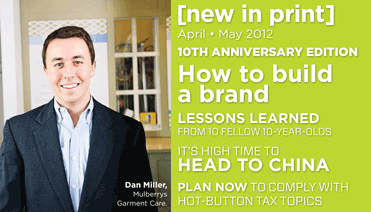
Dan Miller is building Mulberrys Garment Care, a toxin-free dry cleaning business, not only to be the type of place where he wanted to bring his clothes when he was wearing suits for management consulting firm McKinsey & Co. He also believes he can transform the industry in the same way that Starbucks transformed the cup of coffee – especially if he can attract venture capital to invest in new technology. This student of business said he learned hard lessons when he decided to strike out on his own.
Upsize: Describe your company as it stands today.
Dan Miller, Mulberrys: We’ve got five retail locations, one in St. Louis Park, one in south Minneapolis, one in Edina, and two in Byerly’s stores, in Eagan and Ridgdale. We are a toxin-free dry cleaners, so we’re using a new liquid CO2-based process that cleans clothes without the traditional harmful chemicals used in dry cleaning. And we also use environmentally friendly processes that we can find in every step of the process.
We also run delivery routes throughout the Twin Cities, inside and outside the 494 and 694 loop. We’re growing fast. We doubled our revenue from last year. And this year we intend on expanding into one test location in Chicago and one in Long Island, New York.
Upsize: What’s your growth track?
Miller: We went from $1 million in 2010 to $2 million in 2011 and plan to double again this year. We’ve done it through a combination of things. Part of it is natural growth. We’ve seen same- store sales growth over 20 percent, which is highly unique in any retail business. We’ve also expanded our locations each year, so next year we plan on building in-store plant operations. And then we’ll have the locations in Chicago and New York.
Upsize: Why the expansion into those specific spots?
Miller: A couple reasons: No. 1 we wanted markets that were significantly different from ours, so we could actually test whether the concept could work anywhere in the country. Chicago and New York are obviously significantly larger, and in New York you have a significantly different work culture. New York City is an even more buttoned-up culture in the workplace than Minnesota. With the influence of Wall Street, the amount of people wearing suits and ties is even higher than Minnesota. So as a result of that you have a lot of competition as well.
The second thing is we wanted partners that we could work with in those local areas, that we felt comfortable with and knew the area. We were fortunate enough to identify for a lack of a better word friends or acquaintances that had the resources and talent to roll up stores of their own without me having to be there every day.
Upsize: So, why dry cleaning? It’s not the most glamorous business.
Miller: Before I started the stores I was a management consultant with McKinsey & Co, and was fortunate enough to do a bunch of engagements to see a whole bunch of best practices across many industries. I got a good understanding of what it takes to run a great retail operation. I was obviously wearing suits a lot or dress clothes, and one of the things that struck me was the dry cleaning industry as a whole was violating almost every rule for building a great retailer service business. Obviously there are exceptions, but the industry as a whole wasn’t doing the basic things that you would think of.
Upsize: Like what?
Miller: A couple of examples: For example, one of the No. 1 things you want to do to have a retailing service business, is you want to have a great brand that the customer truly identifies with. It’s not uncommon for a dry cleaner not to have a brand of any sort. Obviously it makes it very hard for a customer to either understand what you’re doing differently, or pass on through word of mouth what a great cleaner you are.
When I did market research, one of things I found was the majority of people can’t even name the brand name of their dry cleaner. That’s unthinkable.
For a second was that, in looking at the industry, it drove me crazy this heavy chemical smell in my clothes. I didn’t know what that was at first and found out that most cleaners use a carcinogenic and a groundwater contaminant. Just that that was in regular use – that astonished me.
Upsize: Aren’t other cleaners claiming to be non-toxic?
Miller: Yes, however, there are kind of levels within levels is the best way to put it. In regular use right now, there are four solvents. There’s one called Greenearth is the brand name, but there’s a controversy over that. Then the third is what’s called hydrocarbon, which is a petroleum based solvent, and that’s better than others but it’s still petroleum based. And then there’s our method, which the science says is totally clean and non-toxic.
Upsize: How have you been financing your company?
Miller: I can tell you, it’s really great that you’re writing about this. It’s one of the overlooked areas that we as a society can improve upon to jump-start economic growth. As most people know growing businesses are the ones that create the jobs. One of the hardest things is the credit markets aren’t really set up for you.
The way I funded the business, I started out with money from my own pocket and from my Dad, and that’s how we funded the plant and the one store. At the start it was a million dollar investment. It depends on when you stop counting. But then after that we funded it with small-business lending. We had to operate it a little over a year and a half, before getting that loan. And then the other thing we’ve done is for our Chicago and New York piece we will fund that by a limited form of franchising called an area development model, so you get a partner who will control a particular region and they finance the stores in that region. One of the things that’s difficult, even though you have a track record-if the growth comes fast the results don’t come fast enough to finance the growth.
Upsize: Who’s your lender?
Miller: Unity Bank, a local community bank, all in from them we’ve gotten a combination of loans of a little over a half a million bucks, and that was enough to open the additional locations.
We’re cash-flow positive. In my particular business the startup capital is very heavy, in the million to the million and a half range, but beyond that the needs get lower, because you’re either buying vans or opening stores. As for other forms of financing, for all of our vans we’re getting auto financing. We own the St. Louis Park store, the rest are leased. Ideally everything would be leased, because that frees up cash.
Upsize: How fast do you want to grow?
Miller: I would say we’re go go go with a hint of caution. We want to grow fast, because we believe it’s important to establish your market. However, we don’t ever want to get in the position that the business can’t fund itself. And that’s how we’ve chosen the model we have, with the partners in Chicago and New York. And of course we’re well financed in Minneapolis. But no part of the company is over-extending itself.
Upsize: Did you want to fund this with debt, or were you seeking equity originally?
Miller: I’m 32. I got slapped back on that one to be honest because most of the stuff, when I did research on other similar business concepts and what they’ve done, one of the mistakes I’ve made was I looked at case studies of businesses that grew in the 90s and early 2000s. Like a Starbucks model. Starbucks funded almost all their growth with equity capital, and that worked for them when equity capital was very plentiful and you could get high valuations. But in this modern environment, if you’re a dry cleaner you can’t get capital. Every store would cost me 10 percent of my company. So my original intention was to grow using equity capital and higher valuations, but reality slapped me in the face.
Upsize: So nobody was wild about dry cleaning.
Miller: That’s exactly what happened. I went out and talked to friends of mine in the finance business and the venture capital business. One of the great things was everybody was enthusiastic. And then we started talking about the terms, and there wasn’t a match.
I’d say to some extent for sure that it was a fall back to reality for me. And also, I can candidly say it was frustrating. One of the things that’s funny about the mentality in the equity capital world, is a technology company with zero revenue can capture a valuation of $50 million, and I’m coming at these people with an actual business that has real revenue and real profits and is far less risky, and I’m getting a valuation of a quarter of that.
Upsize: It’s just not sexy to do dry cleaning?
Miller: That’s right, but not only is it not sexy but they’re trying to get home runs. You might get a great return, 20 percent return or more, but because they’re investing in some things that return zero and some wildly better, 20 percent isn’t attractive.
Upsize: So what keeps you going?
Miller: What motivates me is the opportunity to transform what I see is an underperforming industry. Why I got into this buiness was because of my frustration as an actual customer. This is the world of dry cleaning that I envisioned. I walk into it and it smells good and my clothes are marked with bar code technology that tracks through the system and returns to me in a prompt manner and I know that they’re all there. And it’s all done at a price that’s reasonable. That for me was what I envisioned as a customer. What I realized was that wasn’t fully possible without transforming the industry as a whole. Because the whole dry cleaning industry has been set up in a certain way so it stops it from taking a leap forward.
Upsize: What do you mean?
Miller: For example, your average dry cleaner doesn’t like pushing the edge in terms of technology. So old technologies that have been around since the 80s are either non-existent or cutting edge in dry cleaning. You know when you get a package from FedEx they have a hand-held device? Well, when our driver drops off your clothes it would be helpful if we could have that capability, because it’s the same thing. And we still don’t have that in the dry cleaning industry.
So that’s essentially the next frontier for us. We work with the industry as much as we can to push the existing technologies as far as we can. For example, we have an automated sorter, which is leading edge in our industry. But we’ve essentially pushed the industry technologies as far as we can go. So our next frontier for this year is we’re going to put money into research and development to try and develop our own solutions in these problems. And we’ll try to come up with Mulberry’s proprietary products.
Upsize: Are you trying to raise venture money for that effort?
Miller: We’re literally detailing that out right now. For the short run it will be somewhere in the neighborhood of half a million dollars to feed some projects and see where they go. We’re going to try to raise equity capital for that. That really isn’t a quick enough and tight enough investment for a bank. And also there’s an expertise gap. If there are certain angel investors and venture capital investors who have knowledge in these areas, that would work well.
Upsize: This sounds like a more risky effort than your bricks and mortar stores.
Miller: One of the reasons we’re doing it is, when I started out my Dad said, which was very wise: it’s not enough to innovate once and ride that out. If you want to be successful over the long run you have to consistently innovate over the long run. The second you stop someone else will overrun you. You can come up with a concept and coast for a while, but if you stay still
Upsize: Your dad sounds like an important influence for you. What’s his name?
Miller: Bill Miller, he ran Quantum, which did hard drives for computers. That was in California. He grew up here, and then he ran Avid, which makes editing technology for movies.
Upsize: Is he still involved with your company?
Miller: Yes absolutely. It’s more of a check-in, essentially once a month or so. But we do a more formal check-in, where I’ll lay out my vision for the quarter and he’ll give his thoughts or advice.
Upsize: Do you invest in training?
Miller: Yes, but it tends to be very specific to a particular project. So for example, one of the things we’re trying to get better at is the nitty-gritty of pressing clothes well. So we’ll bring in a consultant who has that expertise. She’s widely regarded as a pressing expert, to make sure our people are using all the best techniques.
Upsize: Do you have a large staff?
Miller: We have 50 employees. We essentially have me, then we have a business partner who serves as the president and COO. He handles the day-to-day operations of the business, whereas I’m driving the new locations in Chicago and New York. We have a marketing person who develops our website and branding. We have a person who manages our stores and the routes, a regional manager. And then we have somebody who runs all of our administrative functions, including HR.
Upsize: Isn’t the pricing pressure brutal in dry cleaning?
Miller: There is a lot of price competition. We keep our prices reasonable, so we’re on par with other brand names in the area, but what we’ve done is used our kind of cutting edge knowledge from both a technology and operations standpoint. With the same amount of money coming in the door, we can still drive things down cheaper, especially in the area of labor. There are certain things we automate that other cleaners are doing by hand. But there are also things we do on the supply side that allow us to drive the supply cost down. For example, a typical dry cleaner with a single store doesn’t have a lot of sourcing capability. We use wooden hangars. That’s a huge value to our customer, but we’re able to source that so the price is reasonable. When I was a customer the wire hangers drove me crazy.
Upsize: You and Joan Crawford! Did you grow up here?
Miller: I went to undergrad at Holy Cross in Massachusetts, and then I went to graduate school at the Humphrey Institute, at the University of Minnesota in Minneapolis. I got my master’s in public policy and economics.
Upsize: When you were going to school and working at McKinsey, did you ever think you’d be the dry cleaning king?
Miller: laughs No. If you would have told me I was going to own a dry cleaning business I would have said you were insane. I always wanted to start my own business, but it wasn’t dry cleaning.
Upsize: So why’d you do it?
Miller: No. 1 I was at McKinsey, and I loved McKinsey. It was amazing, but I got tired of consulting for others. No. 2, while I’m an entrepreneurial person I’m not a huge risk taker. Most of my other ideas were so risky and out there I could easily picture myself gong totally bankrupt with the whole deal, which is a scary thought. Which led to a third thing, which was dry cleaning was something I understood on a personal level, and it was an industry I could understand. It didn’t feel like it was a huge risk, just because dry cleaning was such an established business and there are so many established support mechanisms. I thought worst-case scenario, I’d try this for five years and if it turns out I have a little mildly profitable dry cleaning business, I’d sell it and try something else.
Upsize: And what about now?
Miller: Now I’m 10 times more excited about the business than when I started. I think this is an industry that can be changed for good. And I think we have the opportunity to do that. I think the opportunities associated with it aren’t just in the traditional dry cleaning business. The way we think of Mulberrys is Mulberry s Garment Care. Our long-term goal is to not just do dry cleaning, but to be the leading brand in garment care of all sorts. Tailoring, shoe repair, home laundry and cleaning. We recently rolled out our own private laundry collection of cleaning products. So when you think about it in that way, you realize the sky’s kind of the limit. There are so many markets and ways you can change the cleaning business.
Upsize: Do you get impatient, when your goals and dreams don’t match the day-to-day reality?
Miller: Yes. That’s my biggest problem by far. It’s really tough when you’ve got this vision of where you want to go, but the resources constraints are so tight that it slows you down. What I try and do, is lay out what are the two or three top priorities of moving us forward and achieving that vision, and how do we fund those two or three top priorities? If we do that each month and each year we’re making progress toward that goal and I can work with that.
Upsize: What business lesson have you learned, that you’d like to pass on to other owners?
Miller: The best lesson I learned will sound a little bit strange, but it’s that the traditional analysis of what makes a great business opportunity is totally wrong in my mind. The reason I say that is in the textbooks, they use a lot of objective analyses for whether a business is a good idea, and that overlooks some key factors. One of the biggest things that your business school professor will tell you in assessing whether a business is a good idea is barriers to entry. If you can’t create barriers to entry you don’t want to get into a business, they would say. I think that’s wildly overstated in the sense that you can’t overestimates how difficult it is to create a great brand in any business. If you can create a great brand, the power of that brand is an extreme competitive advantage, even if you can’t create a barrier to entry. So the example of Starbucks-you can’t have a lower barrier to entry than a coffee shop.
So everybody, when I looked into dry cleaning, said it’s a bad business because there are no barriers to entry, but in reality it’s just not that easy. The process of creating a business from scratch, creating a brand, and doing it quickly enough to overtake anyone else is just hard.
Upsize: What’s one thing you wish they would have told you, about being an entrepreneur?
Miller: I wish they had told me the incredible amount of crap that you have to deal with. What I mean is, forms you have to fill out for employees, and the figuring out which kind of ceiling tile you want in your plant, and all those little things like expense reports. Things that when you worked in a corporation you didn’t think about-you have to do. When I was starting out I would look around and say, shouldn’t someone else be doing this other than me?