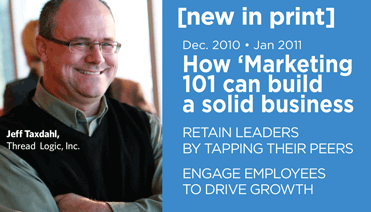
Jeff Taxdahl,
Thread Logic Inc.,:
952.224.9575
je**@**********ic.com
www.thread-logic.com
How Thread Logic’s boss
uses ‘Marketing 101’ to
grow on the web
by Beth Ewen
ABOUT THE CONTEST
The Upsize Business Builder Awards, presented by Winthrop & Weinstine, is an annual contest to recognize the best business-building ideas among Minnesota-based companies with fewer than 100 employees. This fall four finalists, one in each of four categories, were nominations for the impact of their best practice on company performance, and the value of the best practice in helping other business owners. The Jon Charles Salon, Morsekode, Spyglass Creative and Thread Logic Inc. are the finalists. All finalists receive coverage in the magazine, and the Upsize Business Builder of the Year gets cover treatment.
In December their CEOs presented their stories before a panel of judges, in a private session hosted at Winthrop & Weinstine downtown Minneapolis offices. Judges were Terri Banaszewski, vice president with Park Midway Bank in St. Paul; Karen Bertulli, attorney with Winthrop & Weinstine; Wes Bergstrom, president and publisher of Upsize Minnesota in Minneapolis; and Beth Ewen, editor and co-founder of Upsize Minnesota. The judges named Thread Logic as the 2010 Upsize Business Builder of the Year, recognizing its solid approach to sustainable growth. Nominations for next year’s contest open in the fall.
“I’M LOOKING at a cornfield right now. I can look out both windows and see cornfields,” says Jeff Taxdahl, president of Thread Logic Inc., when reached by phone. The nine-year-old, $1.2-million company sells apparel with embroidered logos to businesses nationwide from rented space in Scott County, near Jordan.
When he presented his story along with three other finalists at the Upsize Business Builder Awards judging session in December, he says he felt like the odd man out. Their companies, Spyglass Creative, Morsekode and The Jon Charles Salon, were in Loring Park, Uptown and another Minneapolis address, locations he described as hip, with businesses he saw as sophisticated.
But Taxdahl’s humble location and solid business plan impressed the judges the most. He is the 2010 Upsize Business Builder of the Year, selected for his smart move to e-commerce after two years in business, his skillful execution that led to 20 percent average growth in each of the past four years, and his advice that other small-business owners can use to expand. His story and the stories of the three other finalist companies follow.
Upsize: Describe your company as it stands today.
Jeff Taxdahl: We provide logo-decorated apparel, primarily selling and distributing online. We finished 2010 at $1.2 million. Over the last four years we averaged about 20 percent per year growth; 2009 to 2010 was about 8 percent. Including myself there’s nine of us; we run one production shift. If we grow how we think we will this year, we might add a second shift, probably a partial one-it depends on our commitment to our turnaround times and the stress level we can handle. I have three people who do production and run machines; I have two customer service people; I have a production manager; a bookkeeper; and an art person. Being the chief marketing guru, managing the website and e-commerce falls under my umbrella. I have a relationship with an outside company that handles the technical side of e-commerce.
Upsize: You started Thread Logic after a career setback. What happened?
Taxdahl: I was hired as a corporate communications manager for a technology company in Edina. The first day on the job the board fired the CEO that hired me. That was a shock. In fact, the vice president of sales was my direct boss and she came to my office at 2 o’clock the first day. I hadn’t even found the pencil sharpener or the bathroom yet! And she said, come with me. She introduced me to the board. She said, here’s what we’ve done, now how do we communicate this? That was interesting! Consequently, they went through a re-organization, and four months after I was one of 40 people let go. That had never happened to me before. It was quite a shock. But looking back it was the best thing that could have happened to me. Up until recently I’ve had the letter letting me go hanging in my office, and lately I’ve been tempted to write a thank you letter to that vice president.
Upsize: Why Thread Logic? What made you choose that business?
Taxdahl: We started Thread Logic from zero. In some of the jobs I had, I’d been buying some of this apparel with logos. It was something I felt was a good fit for my skill set. For a number of years I worked for a small community bank in Savage, and I had people I knew who I could get started with right away as customers. It has a low barrier to entry, too. I started with $50,000, buying a machine, buying a computer. I took a loan against a life insurance policy; I had some money that was a personal gift; and I had some savings. This was in January 2002. I had gotten laid off a year before that.
Upsize: What kind of machines?
Taxdahl: Commercial/industrial embroidery machines: it’s a big honking sewing machine. You can get a basic single-head machine for $12,000, all the way up to $100,000 and more. I spent $25,000 on my first machine.
Upsize: What does it take to succeed in your industry?
Taxdahl: When I was looking at the industry, I talked to people that were in it and asked them what it takes to be successful. I asked the question to a guy who was selling the machines. He said, I can tell anyone how to run the machines; the hard part is sales and marketing and running the business. Eight years later I think that statement is absolutely true, not just for my business but any business.
Upsize: You described your location as in the middle of nowhere, in Scott County.
Taxdahl: I’m looking at a cornfield right now. I can look out both windows and see cornfields. We don’t have a retail business so I don’t need a retail location. This location is four miles from my home. It’s less expensive.
We’ve been here 15 years, my family. We have 10 acres. The 10 acres are nice. My wife has animals, a few sheep and horses. My wife grew up on a farm, and when we were making this decision, we wanted to be in the country, but we wanted to be close enough to go to a Twins game or to the Ordway without taking a flight.
Upsize: How do you win against your competitors?
Taxdahl: One of the important lessons I learned in a previous job is, it’s about relationships. We started with that kind of model in mind. We wanted to develop relationships with our customers that are long-term. That’s how I started, and that was the network of people I knew. When we started all of my business was south metro; that was where we marketed. And that is the norm in the industry. And as a matter of fact a lot of the people in the industry have the storefront on main street. We did that for two years, and I started to think about how do I scale up. Traditionally in this business you expand by adding sales people and I wasn’t interested in doing that, partially because I’m a control guy, and partially because it’s very common in this industry that salespeople jump from company to company and take their book of business with them.
It was my brother that suggested the Internet. I remember the first time he brought it up, I said no I won’t do that. My perception was it was all price-driven, you had to be the low-price leader, and it was all transaction-driven, and I like to build relationships. I was trying to do my due diligence and I called an editor of one of the trade magazines, and when I asked him the question if anyone else in the business has this model, he was blank. I thought there was a reason no one else is doing an Internet model, either because it doesn’t work or nobody has taken the leap yet. Lands’ End was doing it at the time. That’s the only name I can think of.
We didn’t launch the site until the summer of 2005. It took me a year to build the site. We make a custom product. It’s a complicated transaction. I had to figure out how can I make this as easy as possible for people to do business with us. At that time too I might have had one production employee, and maybe one other part-time office person. I’m selling, I’m writing checks, I’m doing it all. That’s part of the reason why it took me so long.
It was the fall of 2005 that I figured out, this isn’t a build it and they will come proposition. You have to drive traffic. We started that in fall of 2005. 2006 our revenue was 117 percent higher than 2005.
Upsize: Wow.
Taxdahl: Yeah, that’s what I said! My webmaster was pushing me in this direction as well. I very much had this attitude of, I’m going to try this, I’m going to put my toe in the water. It didn’t take me very long to figure out the water is warm and the pool is deep. Seeing some orders and seeing some success, I got cocky about it. I thought, if you’re in this industry and you’re not doing this, you’re an idiot. I’ve completely changed that. Because what I’ve figured out is, it takes a marketing skill set to make it work.
Marketing, it touches everything. It touches how you build the website. I drive most of the traffic to our website through Google pay per click advertising. It’s marketing 101: it’s knowing who your customer is; it’s knowing what makes you different and then communicating that. We’ve stayed very focused on what we do. A lot of embroidery shops in the United States will take whatever work walks in the door. We target specifically companies. I’m not necessarily interested in the PTA or the sports uniforms for the local school. I think that’s one of the reasons for success, to know when to turn away business if it’s not what you do well.
Upsize: Where are your customers?
Taxdahl: Approximately 10 percent of our orders are shipped here within the state, so 90 percent leave the state. We send 13 percent to California. Our top five states are New York, Florida, Texas, Illinois and California.
Upsize: Describe a turning point for your company, when things began to go much better than before. What happened? How did you make that happen?
Taxdahl: The obvious one is going to the Internet model. But there’s another one. So you know what pay per click advertising is. You go and search on Google, and there’s a box that says sponsored ads. Those people pay to be there, so you click on one of those links and the company pays Google or Bing or Yahoo. I was managing that myself as a small business owner. I started to think, I’m a guy selling shirts and I don’t know how to do this. I came across a company here in Scott County who had been managing pay per click for others, and I hired them. I got five to six months into the relationship and I wasn’t sure it was working for me. I fired them, and I thought I’m going to find a bigger company that knows how to do this. I found one in downtown St. Paul, and I went in there and said I want two things. I want you to help migrate my account from Yahoo to Google, and I want you to be strategic. Again we were five to six months in to the relationship and I began asking some questions.
It was during that process when I had a revelation. I thought, nobody knows my business as well as I do. And I figured out this was a marketing problem, not a technology problem. When people think of the Internet they think it’s about technology.
I discovered there’s a reason they call it Internet marketing. I decided to bring it back in-house. I spent four to five months on a learning curve. I read everything. I went to a conference in Chicago, to learn how to more effectively market in a pay per click world.
For example, the company in St. Paul told me to market on 20 keywords. I had been advertising on 200 keywords. When I got out of that situation I go to this conference, and within the fist 20 minutes they said, successful pay per click advertisers are on 500 keywords. Now I’m advertising on about 1,400 keywords.
So that was a key turning point for me. I’m just a bald white guy over 40, I don’t know everything. But I do know that in this case, it’s a marketing problem, not a technology problem. And marketing is what I know how to do.
Upsize: What about the flip side, a time when things went very badly. What did you do to recover? What did you learn from that experience?
Taxdahl: There’s never been a time when I could define that things went badly. Certainly there’s been a time when I’ve made errors in judgment. One of those times was when we expanded and added an embroidery machine, which had multi-heads. I had it in my mind if I’m adding a machine I need to add a person. It took me a year to figure out that I didn’t need to. I was a little top-heavy on the production side, so I had to let the person go.
I absolutely learn from my mistakes. One of the other reasons we’ve been successful is my wife is my business partner, Wenda. She’s the majority owner. Where I think it works is I’m more of a get it done guy, and she more says let’s think about it, let’s analyze. She pulls back. There’s a good balance between us.
Upsize: If you wrote a motto or slogan about your philosophy as a business owner, what would it be?
Taxdahl: Being a business owner is a lifestyle; it’s not a job. My wife comes from a farming background, and being a farmer is a lifestyle. You work seven days a week. Being a business owner is much the same way. Even though you’re not sitting at your computer, you’re always thinking about it. Some people thrive in that environment, and some people can’t. That’s probably why some fail.
Upsize: What’s the most important business lesson you would like to share with other entrepreneurs?
Taxdahl: A lot of people who are sitting in their cubicle, dreaming about owning their own company one day, are fixated on the new mousetrap. How can I create the next Facebook? How can I create the next iPad? I learned this from the community bank where I worked, from the president. His perspective was, he drew a circle on a paper and said this is all the banking market in the metro and then he drew a line and said if I can gain this much market share I can be incredibly rich.
This is an incredibly unsexy industry and it’s been around for a long time and it’s very stable but I’ve been able to come in and pull some market share in my direction. You don’t always have to look for the new and greatest thing. You can get into established industries and create a good business for yourself.
Upsize: You sound just like Warren Buffett!
Taxdahl: laughs I’m much more micro than Warren Buffett.
Upsize: Everyone is more micro than Warren Buffett.
Taxdahl: Except for Bill Gates.
Upsize: What’s one thing you wish ‘they’ would have told you, about being an entrepreneur?
Taxdahl: I never worked harder in my life. I get 40 hours in by about Wednesday or Thursday. But also it’s incredibly rewarding. When you start something from scratch and build a viable company, you’re employing people in your community and there’s a satisfaction in that.
When it’s your own deal, when you own it, your motivation completely changes.
When I started the company my wife had a real job, and she was very much asking, what if it fails? I said failure is not an option. You do whatever you can, sometimes to the detriment of others. Tom Petters and Denny Hecker, for instance. Your motivation completely changes when you’re responsible for it. That’s probably something I didn’t completely understand until I experienced it.