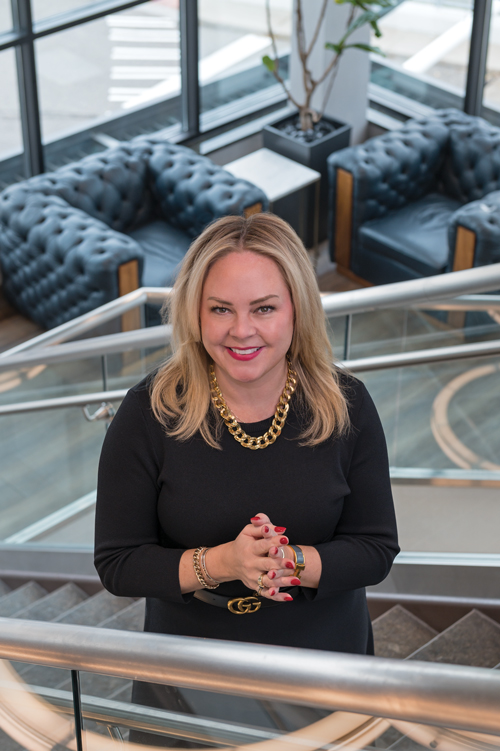
Jay Sachetti joined Jeff O’Brien, partner at Husch Blackwell and Dyanne Ross-Hanson, president of Exit Planning Strategies talked about the market for mergers and acquisitions, exit planning opportunities for companies that don’t end up for sale and how companies can maximize their eventual sale price during an early October panel at the first Upsize on Tap event at Summit Brewing Co. in St. Paul.
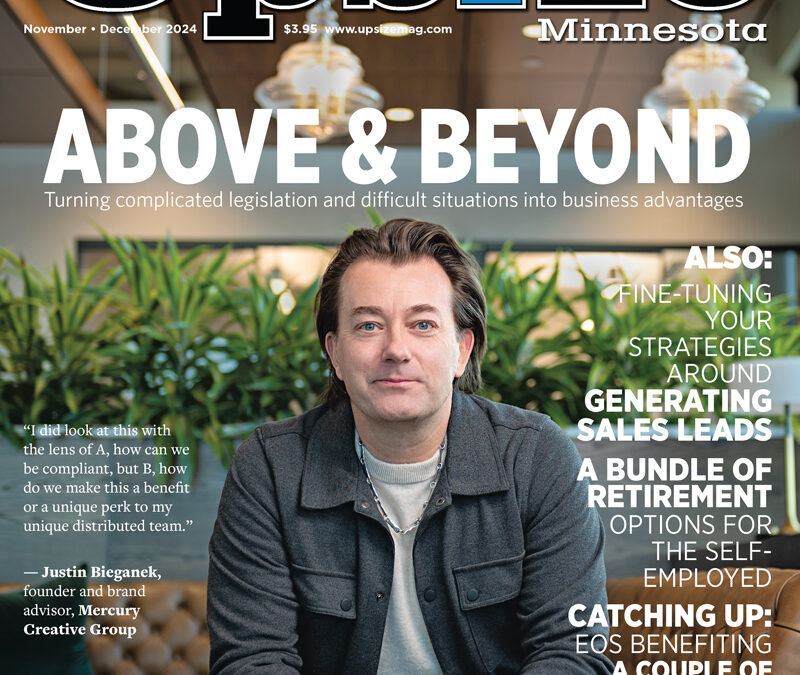
When the state Legislature passed a law requiring employers to provide paid leave and safe time for employees, Justin Bieganek started hearing differing details from friends, colleagues and peers.
Prior to COVID, translation and interpretive services provider INGCO International did nearly all of its work in person. The company flew interpreters all over the world, paid them a per diem, sent equipment and a project manager onsite.
“It was a big expensive cost,” says Ingrid Christensen, president and founder.
And then, all of a sudden, it wasn’t. Just as a contracted Japanese interpreter was getting on a plane to fly to a corporate conference, the client called Christensen to let her know the meeting was canceled.
“We called her and said, ‘can you get off the plane now,’” Christensen says. “She said ‘yeah, they haven’t closed the doors.’ I would be lying if I didn’t say that sparked a moment of panic.”
INGCO was not alone. Media accounts indicate around a year into COVID that between one-third and nearly 40 percent of small businesses closed, at least temporarily, during the pandemic. And, yet many pivoted in ways that not only got them through the difficulties of 2020-22, but also created lasting improvements.
Adapting quickly
For INGCO, after a short time of worry, clients started calling in a panic indicating they still needed to find ways to meet and talk.
“That gave me a moment of pause,” Christensen says. “I’m like, ‘Well, yeah, we can do that.’”
In truth, she wasn’t sure the company could do that, but the demand and the technology were there. With the help of her teenage son Oscar Sanchez-Christensen, INGCO figured out how to deliver its services digitally. “He was, of course, home and he heard me on Zoom saying, ‘How the heck are we going to figure this out,’” Christensen says. “He came up with a whole solution.”
“It was so important for language access and equitable access to language that we just did,” she says. When you’re in the thick of things you just go. You do.”
Ultimately, after several months of 15-hour days, INGCO ended up increasing revenue by 46 percent that first year of the pandemic because it was able to meet the demands of clients looking for online translations and captioning. And much of the company’s business today remains online, though top-line growth has slowed into the mid-20s.
“It was because of our immediate overnight response and our ability to pivot,” Christensen says. “Nobody knew how to do it. Because we were a global company prior to COVID and, essentially, we’ve always been a remote company, it wasn’t that hard for us.”
EOS advantage
One factor in making such a quick change, Christensen added, was her gut instinct to try to please her clients. “When the market shifts or when a client asks you to do something, my intuition is to say yes and figure it out,” she says.
Another was its adherence to the Entrepreneurial Operating System, or EOS, for INGCO’s ability to adapt.
“We’ve always been open to new ideas and to innovation,” she says. “We really were able to put that into practice.”
That makes perfect sense to Tamara Prato, a business growth adviser, EOS implementor and CEO of Connect The Dots LLC.
The sweet spot for EOS is companies with 10 to 50 employees and the whole premise of the system, she says, is that it is about harmonizing human energy and getting everyone on the same page.
It gets leadership on the same page, as they are to agree on the top three to seven most important priorities, Prato says, and then creates discipline and keeps everybody away from “other shiny objects” for the next few months.
“It’s getting everybody on the same page, going in the same direction,” Prato says. “It creates clarity about where we’re going, how we’re going to get there, why we’re doing it. It helps from a prioritization standpoint.”
And it keeps staff on track, with weekly 90-minute L10 meetings where everyone checks in on the important metrics. “I think it’s just that general cadence that helps companies stay on track,” she says. “It takes discipline and accountability as a leadership team to do it. It isn’t just like a magic wand.”
Adoption of EOS actually increased during COVID as companies had to make difficult decisions to ensure their survival.
“They had to get down to brass tacks,” Prato says. “They had to be like ‘We need to look at everything we do and does this fit in with what our core focus is? Or do we actually have to pivot?’”
MetroConnections tears down silos
A similar shift to virtual events took place at metroConnections, a 35-year-old leader in producing large-scale events and conferences.
While 2019 remains the best year the company ever had, 2023 is coming close. “We’re happy to be back,” says Tom McCulloch, chief marketing officer and co-owner. But back in March 2020, that was no sure thing. Much like with INGCO, clients shut down events almost immediately.
“There were definitely a few weeks of ‘Oh my God, what are we going to do’ panic,” says CEO David Graves. “But we got to work pretty quickly with leadership, our team, to devise the plan to survive this and to pivot to virtual quickly and use the resources and the people. We did it very quickly and we got up and running to be able to offer a solution to clients.”
Back then, the company had four distinct business divisions: a conference services division that did meeting management, name badges, online registration and other services; an event division that focused on large networking events and related pieces like décor, furniture and centerpieces; a transportation division that picked people up at airports, got them to hotels and brought them to offsite events; and then there was the fast-growing production division focused on general stage production and speaker management.
“What COVID taught us was we had a lot of walls in these divisions and it was rare that you could tap into resources within a particular division for another division that seasonally might have a little more volume,” McCulloch says.
The company had already been producing and streaming some events for live audiences, but not in a mass way. When metroConnections does an event, it assigns a show producer and a technical director. The company had several people who could do that but had downsized staff when in-person events closed down.
With multiple virtual shows per day and week, it needed both equipment and more managers to support the shows.
The company dropped all divisions and it became all hands-on deck. “Could we teach them and make them adapt to this environment?” McCulloch says. “We had event people and transportation people who were now technically supporting virtual speakers behind the scenes.”
The company invested in equipment, stripped out offices, turned them into studios and did whatever it took to keep customers happy.
The virtual shows, with the help of its VEX Pro tool that creates realistic virtual offerings and exhibits, kept the company going and, due to declines in travel and other costs associated with in-person shows, actually made better margins during COVID.
Since conferences and events have largely returned to in-person meetings, metroConnections’ new expertise in digital events is only a small part of the company’s current revenue stream.
But some of the improvements that went into making that happen — such as the breaking down of the barriers between business units — have definitely made the company more efficient and collaborative today.
“Now, we still have people that specialize in online registration or events, or transportation,” McCulloch says, “but, from a people management perspective, we restructured in a way that allowed our management team to tap into resources when we’re heavy in one area versus another.”
Employee loyalty helped
There were many low points as the transition kicked off, the worst of which, says David Graves, was realizing COVID was not going to be a 90-day event.
“We all thought that’s what it was going to be,” he says. “The thing that got us through that was our pace of new business on the virtual side.”
And what got metroConnections through that transition, they say, were a lot of long-term, bought in employees who, even upon hearing that many colleagues were furloughed, plowed forward into new roles and long days of meeting clients’ needs.
Ownership had just implemented an Employee Stock Option Plan (ESOP) and the Graves brothers and McCulloch all say that played a significant role in keeping the company afloat in order to make the pivot.
“I really think it helped us get them to buy into this new direction and roll up their sleeves and say, ‘whatever you need me to do,’” says Mike Graves, chief financial officer. “People had to change career paths and, in some cases, completely shifted to doing something else. I think the fact that they were employee owners, they took that to heart, saw the business and said, ‘We’ve got to make this work.’”
New customer base meets old values
Belo Cipriani, blind since 2007 after an attack while living in San Francisco, owns Oleb Media, a company that helps businesses make sure their websites, apps and other technology are accessible to those with disabilities.
Before the pandemic, Oleb Media focused on performing these audits for the hospitality industry, particularly hotels and resorts.
“During the pandemic, that went away, so we had to reinvent ourselves.” says Cipriani, adding that such companies were among the first sectors to try to become accessible to those with disabilities. “They had to retrofit their hotel rooms and lobbies and everything to make things accessible to wheelchairs and so on. So, when I approached them and said, ‘Is your website accessible,’ they said ‘No, please help us.’ It was an easy way for us to set up our company in 2018.”
When the pandemic hit, Oleb began working with educational companies, who suddenly had to refine their online presence for Zoom and other online meetings. It also brought Cipriani back to his roots as a teacher — he has a doctorate in education.
So, where most of the hospitality companies wanted Oleb Media to simply do the work for them, the vast majority of his clients now are looking to be taught how to do the work themselves.
I feel like I really found my spot,” he says. “Now, the clients we are serving really match my value system.”
About 80 percent of his clients are now in education and most of the rest are nonprofits, largely in the arts, where much of his training revolves around helping them with the educational components of their displays.
Cipriani says an upside of being forced to change during the pandemic was being forced out of his comfort zone and into getting creative about diversifying revenue streams. He has created an online academy that launches in December where he’ll constantly be designing new products spinning forward what’s next.
“I want a dedicated time and space where I am looking at what’s next,” he says.