Jay Sachetti joined Jeff O’Brien, partner at Husch Blackwell and Dyanne Ross-Hanson, president of Exit Planning Strategies talked about the market for mergers and acquisitions, exit planning opportunities for companies that don’t end up for sale and how companies can maximize their eventual sale price during an early October panel at the first Upsize on Tap event at Summit Brewing Co. in St. Paul.
When the state Legislature passed a law requiring employers to provide paid leave and safe time for employees, Justin Bieganek started hearing differing details from friends, colleagues and peers.
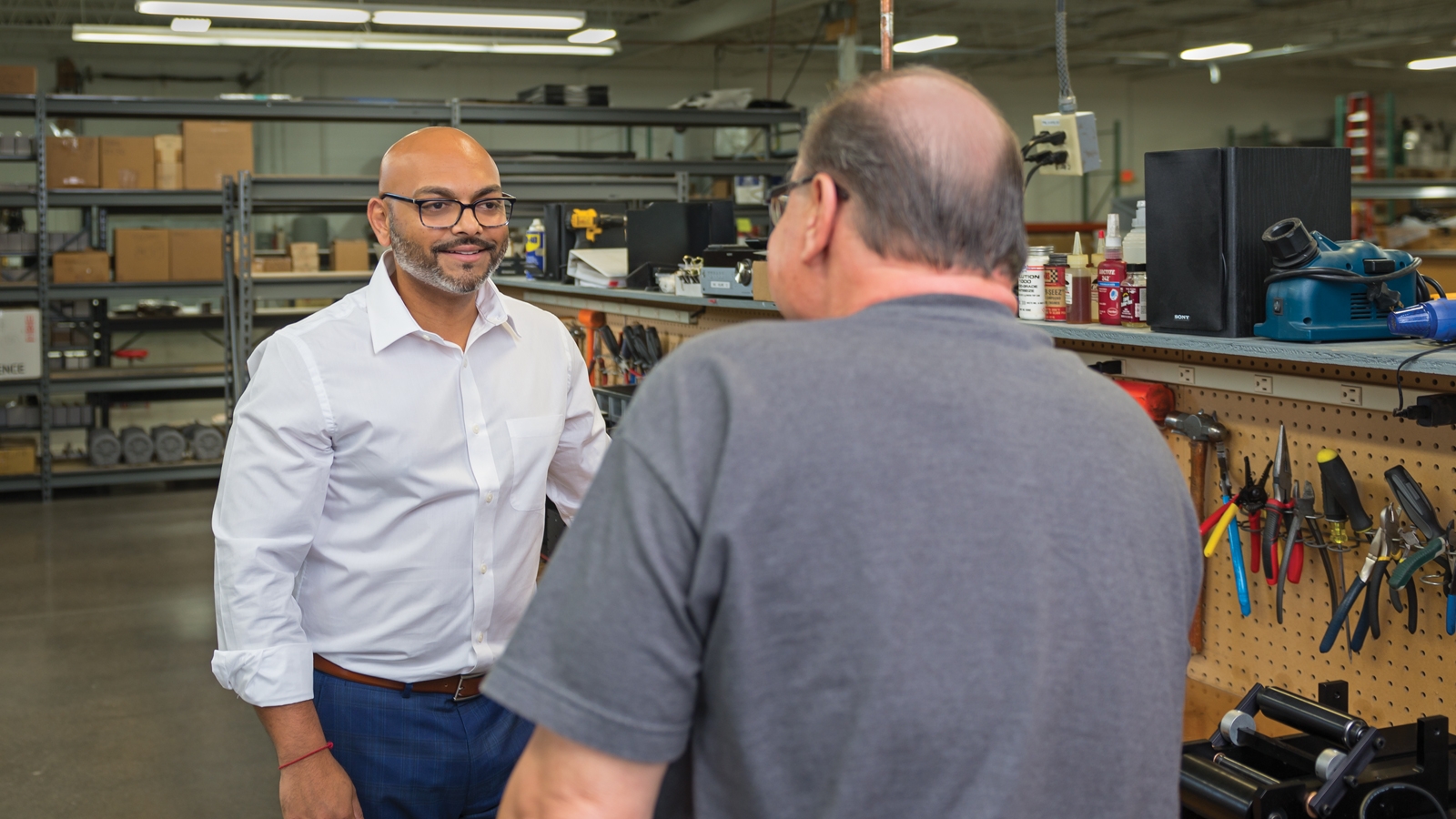
When Dipesh Patel acquired Postmatic two years ago, he was looking to rapidly expand the manufacturer of equipment for mailing, packaging and semiconductor industries that also does contract work for original equipment manufacturers.
In the last three months, Postmatic has acquired another company and purchased real estate aimed at eliminating the cost of rent and facilitating the company’s ability to take on larger builds.
So, Patel is familiar with what it takes to get financing, both in good times and bad.
During these recent transactions, he worked with the same banker who first helped him acquire the company, so they have a comfort level together. The process was transparent, but it took a long time and rising interest rates have made it harder to pinpoint the company’s true costs.
“It’s getting a little bit more administrative intensive to secure all checked boxes on the lender’s side,” Patel says. “The process has been lengthy.”
And there also has been some uncertainty about what the deal’s structure would look like with increases in interest rates.
“It makes it a little unclear what you are getting into,” he says.
Financing, costlier, but still available
When Patel was acquiring Postmatic he met with John Thwing after his broker suggested they connect. He liked Thwing’s transparent approach and his advice, which built a level of trust. Thwing has since switched companies, but Patel stayed with him for the latest transactions.
“We stay in touch, make sure he’s aware of what I’m doing,” Patel says.
That’s important all the time, financial services industry sources say, but it can be especially helpful during difficult times. Because right now, Thwing says, it isn’t just interest rates making deals a bit more challenging.
Labor shortages, supply chain challenges and the increasing cost of capital have affected small businesses recently. Those factors haven’t completely depleted the availability of financing, at least through the U.S. Small Business Administration, says Thwing, who does mergers, acquisitions and expansion deals for Live Oak Bank.
He acknowledged that inflation can be a drag on margins but adds that most markets have been accepting of price increases, important as companies manage their financial health and viability for growth.
Thwing recommends companies take a thorough look over all their finances as they prepare to seek funding.
“Owners understandably focus on the income statement when looking at their performance, but don’t ignore the balance sheet when looking at your company’s financial health,” he says. “Pandemic-related stimulus funds like SBA EIDL (economic injury disaster loans) are great sources of capital, but that additional debt can impact your borrowing capacity.”
A visit to your lender can help determine appropriate debt-to-equity structures and financing amounts and terms. Some banks, Thwing adds, have started increasing their underwriting requirements while others with healthy loan portfolios are continuing to lend as they did previously. That said, with the prime rate up significantly in recent months, “a business that qualified for financing in a low/flat rate environment may not qualify for financing in a moderate/raising rate environment,” he says. “For healthy businesses with good trends, margins and cash flow, SBA financing should continue to be available.”
Demand still strong
As noted, there are several significant factors affecting the availability and ease of acquiring funding right now. The cost of equipment in many industries has gone up significantly, as well. But that hasn’t killed demand, which remains strong in capital equipment leasing and financing, says Brian Bourne, who does business development for KLC Financial.
“That’s unfortunate for the business owner, but they still need the equipment,” he says. “With seemingly almost everyone I talk to, you ask them what their biggest issue is, it’s staffing. They just don’t have enough people to man the machines.”
That’s driving companies to purchase equipment to help automate, to maintain their output with fewer people hours to run it. Companies are willing to pay a bit more right now because it’s been harder to get equipment in a timely manner and that may not improve in the near term, he says.
“Those folks who say, ‘this is 10 percent more expensive, 20 percent more expensive than it was this time a year ago, I really don’t want to pay that,’” Bourne says, also realize that if they wait, the costs might go up again and it might take even longer to get the equipment.
“The whole pipeline of equipment being so far delayed is still driving a lot of the demand and decision making,” he says. “It certainly is tougher to be a business owner. Yet, they still need this equipment, so they are still willing to pay the inflated prices. Their costs to customers are going up too.”
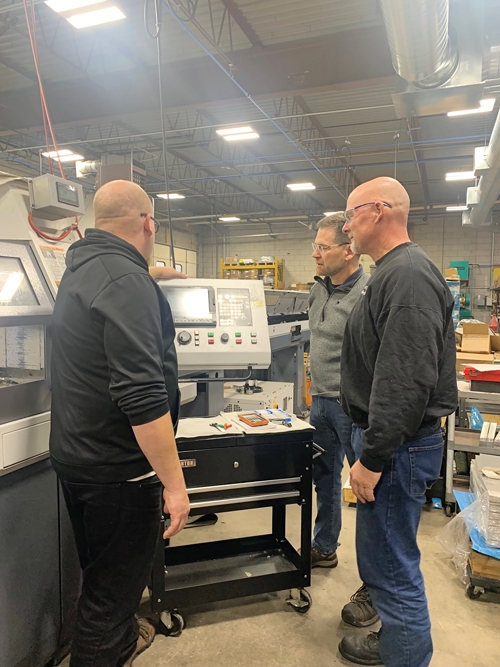
That’s almost the exact situation that was facing Gary Noel, owner and president of B&E Tool.Noel bought the company in 2018. It’s a precision machine facility in Fridley with 11 employees. The company specializes in high-mix, low-volume parts for test systems, medical devices, military equipment and other industries. So, each employee will work several jobs a week.
“We’re not huge, but some of the stuff these guys do is just amazing,” says Noel, CEO. “There’s nothing these guys can’t do.”
The company has gotten into Swiss manufacturing, a characteristic of which is someone running 10,000s of parts in a run. B&E purchased a Swiss machine about two years ago and has been successful with it. The company can do products up to 20 millimeters in diameter on its existing equipment but wants to add another machine that will allow for manufacturing slightly larger parts, up to 38 millimeters.
As many are saying now, Noel was cautious because of rising interest rates. But he also felt strongly the company needed the new equipment to continue meeting growth goals and also believed it could cash flow the machine quickly. So, he attended the International Manufacturing Technology Show (IMTS) in Chicago in September and, as a result, was looking at a couple different machines. One company indicated it could make such equipment available by early 2024. That wasn’t going to work.
“That was a huge deal for us,” Noel says. “One of the things we’ve been able to do with some of our customers is we’ve been able to create some capacity with the way we do things with these machine purchases. We give them delivery dates other people can’t or won’t. But if you’re waiting 18 months for a machine, it’s tough to have the capacity you need.”
Another company, however, had one where if Noel acted quickly, he could have the machine in-house and up-and-running by the end of November. Noel met KLC’s Bourne at a networking event tied to IMTS show. They had some good conversations there and arrived at a deal that had some flexibility where B&E could pay a bit to buy down its interest rate if it saw the anticipated growth with its new machine quickly enough.
“They were able to respond in a timely manner,” Noel says, adding that B&E has already had productive conversations with at least one surgical instrument customer eager to do business with a manufacturer that can turn parts quickly.
“Brian and his team actually made it quite easy, as far as financing,” Noel says. “This acquisition made sense for what we are doing and what we are wanting to do, get into some new markets.”
Bourne says KLC Financial has tightened its credit requirements on deals on certain industries where the current economic environment has made business tough, but it’s still not impossible even for companies in struggling markets to get financing under the right circumstances.
“A year ago on the fence, we’d probably have leaned in and said let’s go ahead and take on the risk,” he says. “Now, those borderline deals, well, we’ll be willing to do it but maybe we need more money down or additional collateral to secure our loan to debt ratios. The process has not changed, but what the terms ultimately look like, we’re a little more cautious.”
Tightening at traditional banks
Money will be available from traditional banks, as well, though there will likely be a general tightening, says Mike Heil, senior vice president of commercial lending at Fidelity Bank. At the same time, with the government money that was available to get through the pandemic, many small businesses are in better shape heading into a recession than has typically been true in the past.
“For those that managed their way through this, took advantage of PPP funds, built some cash up and were very successful in most industries in earning record-year profits, they’re uniquely poised going into this recession in better shape than they historically have been,” he says.
Heil says Fidelity will be looking for clients to have strong liquidity and capital ratios and diversified revenue sources that will help them through a recession when their business-to-business customers are going to be pulling back on inventory.
He wants to see businesses that have a plan, that are regularly projecting out and refreshing their cash flow forecasts and that are planning for some ups and downs. And it can’t be overstated how important it is to have the ability to pick up the phone and call your banker.
“The thing I would emphasize the most from a small business provider’s perspective is make sure you have that ongoing relationship with your lender,” Heil says. “With the entrance of fintech companies and technology-based credit sources where getting credit was easy, those are going to tighten up. Without having a good story to tell or a lender who knows who you are and understands your ability to manage through ups and downs, who knows your business well, it’s going to be harder for small business owners to obtain the financing they need.”
Business picking up in factoring
Kristin Erickson is senior vice president and managing director at SLR Business Credit, which is a collateral driven working capital provider that does receivables-based financing and asset-based lending.
She’s seen business pick up the last month as it appears that the seemingly never-ending pool of pandemic loans has ended.
“Since COVID hit, there’s been round after round after round of free money from the government, some of which folks needed and some of which they didn’t, but it came regardless,” she says. “It just sort of kept coming. I think we’re at the end of that. … During COVID, it was ‘why borrow from me if you can get it free.’”
But the company’s collateral driven working capital product is a good fit in times of distress or in times of fast growth. With the complicated economic factors facing businesses these days, Erickson says her phone is getting busy.
“Our clients are either growing too fast or they’re struggling,” she says. “For whatever reason they don’t fit into the conventional bank financing box.”
A downside of these types of loan products is higher interest rates. Some customers stay with SLR longer than they have to because the company often does deals with few or no covenants, Erickson says. But often, when they can, they’ll find another lender that can offer lower interest costs.
“If you’re looking for a new credit facility and the one the bank is offering has a lot of covenants you think you’re going to trip and be in default, you’re going to want to think long and hard about that,” she says. “It’s easier to look for financing when you’re not under the gun like that.”
Erickson would counsel people to be mindful of how rising interest rates, inflation or supply chain issues might affect them and be realistic about their financial projections for the next couple years. She also wants to see companies come to the table with a well-constructed plan.
“We’re going to want to know if they’ve experienced some recent struggles or they have supply chain issues or their margins have shrunk because their input costs have gone up,” she says. “Just what is the plan. Be able to articulate the go-forward plan in a credible way.”