Jay Sachetti joined Jeff O’Brien, partner at Husch Blackwell and Dyanne Ross-Hanson, president of Exit Planning Strategies talked about the market for mergers and acquisitions, exit planning opportunities for companies that don’t end up for sale and how companies can maximize their eventual sale price during an early October panel at the first Upsize on Tap event at Summit Brewing Co. in St. Paul.
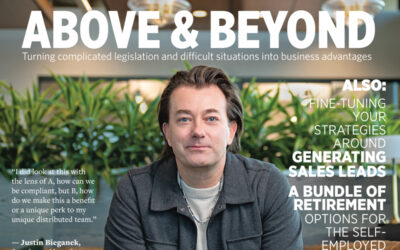
When the state Legislature passed a law requiring employers to provide paid leave and safe time for employees, Justin Bieganek started hearing differing details from friends, colleagues and peers.
LIKE MOST small-business owners who fought through the last recession,
Lisa Hannum felt wrung out afterward. “I felt personally low energy. I felt something had to shift,” the founder of Beehive Strategic Communications told me. “I went on an extreme personal journey to boost my energy,” and then she began bringing her staffers into the process.
We met on a sunny Tuesday in April in her Bandana Square offices, after her company’s weekly professional instructor-led yoga class, which was followed by a healthy lunch, prepared by a rotating staff member who also shares each recipe.
Those weekly events were just two examples of what has become a six-year process that has transformed the public relations firm into a working lab for healthful practices. Hannum believes any small-business owner can incorporate their own version into their workplace, and in her mind, every small-business owner must do so in order to build “strong and resilient” employees who can do their best work for clients, as she puts it.
Rebecca Martin, vice president of culture and talent, took me on a fast tour around the office, which employs 15.
There’s the whiteboard, on which staffers write each Friday three goals and one energizing practice they’re committing to achieve the following week.
At happy hour on Thursday, everyone will report how they did.
There’s an appreciation jar, in which people write comments about colleagues or clients.
They’re read out loud at the annual holiday party. There’s Norm the dog and many other furry friends, which are allowed in the office, to the consternation of myself, one of the few people who will admit to disliking the pets-at-work trend, but of course this story isn’t about one person’s preferences but rather about building an entire culture.
There’s the Bagua feng shui board, which displays qualities such as “wealth” and “empowerment” and the corresponding color purple, for example, that exists in each workspace.
And there’s the InZone, a meditation room with candles, slouchy chairs and perhaps most importantly, a shield underneath the first layer of paint that blocks WiFi so people can meditate, power nap or write in peace. “It’s really meant to be an oasis,” Martin says.
There’s quite a bit more to the culture, too, and if I’ve lost anyone on the feng shui, the meditation room or anything else, Hannum’s stats should snap you back to attention. The number of sick days taken at Beehive has declined by 60 percent over the last two years. The five-year talent retention rate is more than 95 percent. Revenue has increased 19 percent on average over the last four years, with—wait for it—zero increase in the average number of hours worked per employee. (That remains at 42.) And while Beehive spent as much as $25,000 to $50,000 a year on outside recruiters as recently as three years ago, today that expense is zero, with Martin’s holistic approach yielding better results than in the past.
Hannum hears all the time a common refrain: How can she afford to spend so much on creating a culture that supports employee well-being? “When you ask yourself is this really something I could do, you have to think about, can you afford not to?” she replies.
“It takes a lot of resilience to be in business today.”
I’m hoping Hannum’s approach strikes a chord for all small-business owners. What could your employees create, if you made their well-being your top priority?