Jay Sachetti joined Jeff O’Brien, partner at Husch Blackwell and Dyanne Ross-Hanson, president of Exit Planning Strategies talked about the market for mergers and acquisitions, exit planning opportunities for companies that don’t end up for sale and how companies can maximize their eventual sale price during an early October panel at the first Upsize on Tap event at Summit Brewing Co. in St. Paul.
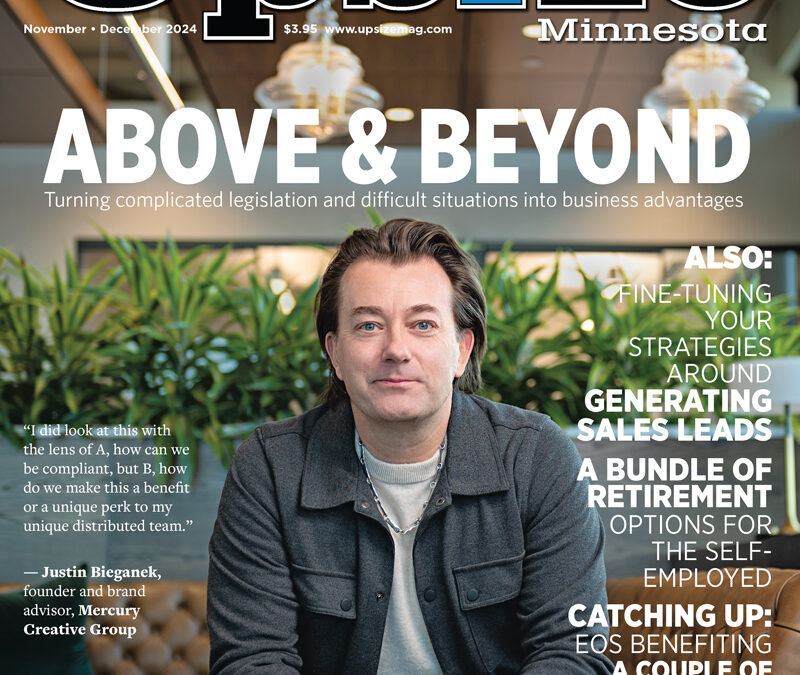
When the state Legislature passed a law requiring employers to provide paid leave and safe time for employees, Justin Bieganek started hearing differing details from friends, colleagues and peers.
1, Consider finding leadership development opportunities for “cultural sparkplugs” - leaders among their peers who have earned the respect of senior leaders and understand the organizational pulse. They can add more diverse perspectives to the strategic planning process.
2, Change is expedited when you open yourself to thought leaders from various fields and disciplines, develop insights from loose connections and open yourself to interrupting patterns, challenging assumptions and shifting perspectives.
3, Change doesn’t always happen correctly right away. Leave room for course correction. Remember you can likely do less than you think in the next 90 days and more than you think in 12 months.
4, Success comes from stretching our thinking of what’s possible, what’s beneficial and from creating alignment, both within teams and across the organization.
Leaders across industries, company sizes and ownership structures are facing similar challenges in today’s competitive environment. At the same time, these leaders are expressing their desire for a strategic planning process that starts with a blank sheet of paper and recognizes their unique way forward.
From publicly traded to private equity-backed companies to those that are family-run, employee-owned or non-profit, businesses are wrestling with increased regulation, economic uncertainty, continued labor shortages and a need to inspire greater employee engagement.
Through it all, they are asking themselves questions about how they might build better strategies, develop stronger leaders and elevate team performance for sustainable growth.
Over the past several months, we’ve captured the topics that are top of mind for leaders related to strategic growth, team development, innovation and creativity, culture, identity and succession.
Leaders are expressing a need to:
“Move beyond the tactical and into more strategic thinking to capitalize on success and avoid resting on our laurels.”
“Reenergize new product development efforts to inspire new thinking for creating what’s next.”
“Transform a group of exceptional individuals into a cohesive and high-performing team.”
“Work through a culture battle between long-tenured employees and individuals who have been with the company a relatively short amount of time.”
“Develop a renewed sense of purpose and values to help drive a culture that everyone can see and feel.”
“Cast a vision that supports our choices for staying ahead of the curve in a changing world economy.”
“Ensure we have the organizational structure to realize the vision and explore the levers to pull to maintain an accelerated trajectory.”
“Address succession planning which presents one of the greatest near-term risks facing our organization.”
“Balance the positive force of stretch goals with the need to experience progress through more attainable goals to ensure people don’t give up in the process.”
“Unite the team and develop our ability to approach each other and clients with greater curiosity.”
“Ignite creativity to drive innovation and enhance storytelling to bolster a leadership culture.”
“Rejuvenate our fatigued leadership team who is at risk of burnout.”
“Learn to respect one another’s point of view.”
“Break down silos to recognize we’re all on the same team and more intentionally start rowing in same direction.”
Igniting the cultural sparkplugs
As you may be navigating similar challenges and opportunities, consider a few concepts we espouse: Engaging the right people in the most creative process will ignite their genius. Deeper curiosity and creativity will uncover new insights. A disciplined approach will help converge on the best actions for achieving desired results.
Engaging the right people is critical to success. One guiding principle is to reach deeper into the organization to gain insights from “cultural sparkplugs.” These are the individuals who are leaders among peers, have earned the respect of senior leaders and generally have their finger on the pulse of the organization.
The goal is to create a leadership development opportunity for these individuals and add more diverse perspectives to the strategic planning process.
Create a platform for these individuals to showcase their strategic thinking, own a part of the plan and get exposed to critical components of the strategic planning process. This not only helps to create a more robust plan, but it also increases alignment throughout the organization.
Stretching minds through new experiences
Designing a creative process means focusing on relationships and experiences for elevating clarity, alignment and commitment. Inspired by the Oliver Wendell Holmes quote, “A mind stretched by a new experience can never go back to its old dimensions,” companies should welcome the opportunity to stretch for new results.
When you open yourself to new experiences and new thinking, you start to see new ways forward and begin to make better choices for better results. Change is expedited when you open yourself to thought leaders from various fields and disciplines, develop insights from loose connections and open yourself to interrupting patterns, challenging assumptions and shifting perspectives.
Converging on the best actions for achieving your desired results is dependent on your willingness to make difficult decisions. Create space to dream big and remove constraints to thinking in new ways. Also recognize the value of discipline.
Make decisions for moving forward while building adaptive capacity to course correct as necessary. Remember that you can likely do less than you think in the next 90 days and more than you think in the next 12 months. Focus on what’s most important today with an eye on tomorrow and avoid the temptation of taking on too much.
All of this for the purpose of unleashing the power of your clarity, alignment and commitment.
Gain clarity on the questions of “Who are we (purpose and values)?” and “Where are we headed (vision)?” Our purpose and values tell us and others about who we are, why we show up and how we show up each day. Our vision should inspire us individually along with the teams we lead and customers we serve, and it should inform our efforts.
Seek to achieve alignment on the choices we will make to live out our purpose and values in the direction of our vision (strategy). Strategy is about the choices we make. Our success comes from stretching our thinking of what’s possible, what’s beneficial, and from creating alignment within the team and across the organization.
Get commitment to move forward together means doing what it takes to effectively chart the course (culture and team performance). Our culture is meant to fuel our strategy and a culture of commitment drives accountability and team performance.
As you move forward in pursuit of clarity, alignment and commitment in your strategic planning, remember to reach deeper into the organization to engage and develop your people, open yourselves to be stretched through new experiences, seek deeper insights and build your discipline for the best action.