Jay Sachetti joined Jeff O’Brien, partner at Husch Blackwell and Dyanne Ross-Hanson, president of Exit Planning Strategies talked about the market for mergers and acquisitions, exit planning opportunities for companies that don’t end up for sale and how companies can maximize their eventual sale price during an early October panel at the first Upsize on Tap event at Summit Brewing Co. in St. Paul.
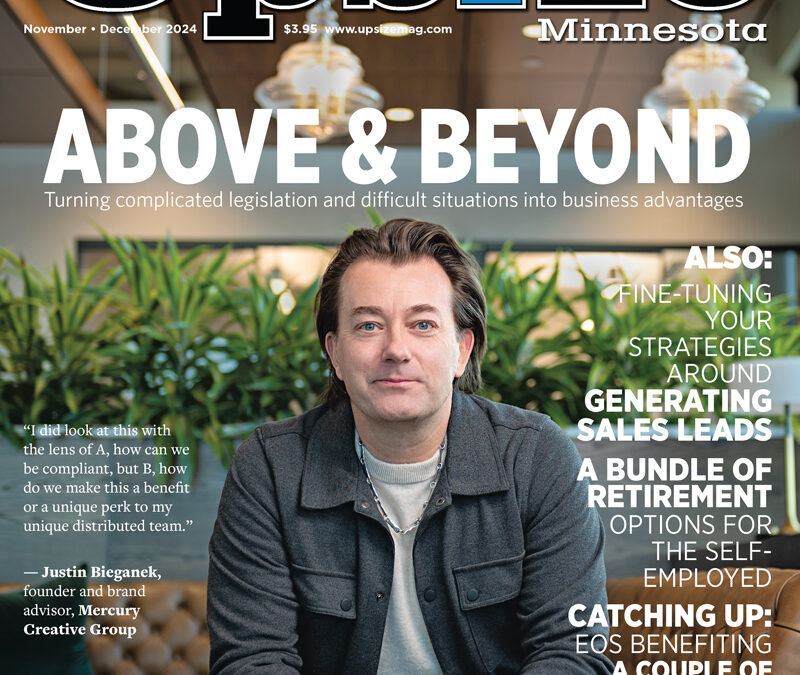
When the state Legislature passed a law requiring employers to provide paid leave and safe time for employees, Justin Bieganek started hearing differing details from friends, colleagues and peers.
Beehive Strategic Communication helps business owners solve complex challenges thus helping them grow. But the communications firm has been working for more than a decade to do a better job on its own of being conscious of diversity, equity and inclusion (DEI) as part of its business practices.
“It was not something that was sparked by social change specifically or by a George Floyd event,” says Lisa Hannum, founder and CEO. “We operate from a clear company purpose and values. Growth-minded equity is a key value for us. That lays the foundation for who we say we are as a company.”
Beehive also increasingly coaches its clients on DEI issues, as well, helping them understand and identify their values in business.
“So, it’s employees, it’s partners, it’s vendors, it’s customers and the communities you operate in,” Hannum says. “That could be your geographic communities, it could be professional communities that your business is part of — we look at communities as sort of these ecosystems that surround me. And so that behavior contract goes both ways.”
How to go about it
So, given Beehive’s culture and its commitment to doing right on diversity, how did the company go about it? For one thing, it got certified.
B Corp Certification, overseen by B Lab, aims to provide companies with programs and tools necessary to understand their environmental and social impact. The organization works with companies of all sizes on working toward the goal of making all business a force for good, according to its website.
B Lab has free assessments available to help clients measure, manage and improve their impacts. There are about three dozen companies with ties to Minnesota that have been certified.
“What it did was give us this incredible assessment tool that provides a comprehensive and rigorous roadmap. And they dig in on policies and workers and vendor diversity,” Hannum says. “It’s a really great roadmap for companies of every stage and every size.”
Both Beehive and its clients utilize the tools to ensure they are widening their focus and not searching too narrowly when recruiting employees and clients, she says, indicating that many employers and small business leaders throw up their hands and say there aren’t any options in Minnesota without recognizing how diverse a state it is.
“Small businesses tend to focus too narrowly on diversity,” she says. “When we talk about ensuring that we’re becoming diverse, it’s in every demographic area, age, race, sex, gender identity and ability.”
As of yet, Beehive’s employees are largely white, but Hannum says there are leaders in the organization from the LGBTQ-plus community, there’s diversity in age and people who are neurodiverse.
“That’s what the social contract is becoming for employers,” Hannum says, adding that it’s not only a legal expectation that people from these communities will have fairness, but also an expectation of younger workers — future leaders — that this will be true.
“For [Generation Z] and millennials, what small businesses have to think about is, this is our workforce today and certainly of the future,” she says. “And when it comes to social contracts with Zs and millennials, they are not up for negotiating diversity, equity and inclusion. It’s simply who they are.”
Taking it seriously
While Beehive has been working on its diversity efforts for many years, DEI efforts spiked three years ago in the wake of George Floyd’s murder in Minneapolis. Sara Taylor got a lot of calls from companies wanting her to speak on diversity for a half-hour at a team meeting.
There was also an uptick in reach-outs from companies saying they really wanted to do it right. Some have followed through. Some have not, citing economic challenges or the war in Ukraine.
“There has definitely been a retraction in the last year or so,” says Taylor, president and founder of deepSEE Consulting.
Those that stick with it, she says, often don’t realize going in the commitment it will take to do it right or the transformational nature of the process.
“They think of it as just, ok, we just need to focus on recruitment and be more diverse or we just need to have a couple trainings and then that’s it,” she says. “Our approach is about we follow research that shows levels of actual competence and how we see and respond to complexities of difference.”
What that looks like
What that means is that without developing true competence, you’re not truly going to organically bring in diversity or create inclusion.
“The vast majority of individuals in almost every single organization are operating at the lower levels of competence,” she says. “The mistake organizations make is to go about the work before doing that development. It’s kind of like giving me a Ph.D. level math test but I haven’t taken a math course beyond the first year of college.”
That starts at the top with leadership, Taylor says, adding that she almost never sees an organization more developed than its leaders’ levels of qualification.
“Commendable leaders are taking on first their own awareness of their unconscious filters and how they’re making ineffective decisions,” she says.
The second step is making sure diversity efforts aren’t just checking a box but are truly developmental. Whether it’s hiring staff, finding vendors or some other area, data drives the process, not guesswork, Taylor adds.
“We’ll do a data driven analysis, not just a hunch-driven or guess-driven or a ‘what is another organization doing’ driven analysis that looks at every step in the selection process,” she says. “Do they pass the minimum qualifications? What’s the next step? Did they make it through the first interview? Did they make it through the second? Did they get the job offer?”
At each step, deepSEE looks at whether the results met the organization’s goals and was reflective of the available pool of candidates.
If, for example, the percentages add up all the way through the process until the hire, she says, “That says it’s not about recruiting. It’s not about the available pool. Where it does fall off is when the hiring managers get involved,” she adds. “And it’s not because these folks are bad people. It’s not because they are saying ‘Oh, no, we don’t want diversity. It’s because they haven’t developed. It’s because they don’t even realize how they are not seeing the best candidates.”
Taylor has had hiring managers tell her after going through the training program that they thought they were hiring the best person regardless of demographics, only to learn they didn’t know what they should have been looking for.
She says it’s not about revealing a business owner’s or hiring manager’s personal flaws. It’s about building organizations up to ensure everyone is on a level playing field and that companies actually do bring in the best people.
“That intervention is to develop your hiring managers and give them specific tools they can use in that hiring process,” she says.
Work in progress at Science Museum
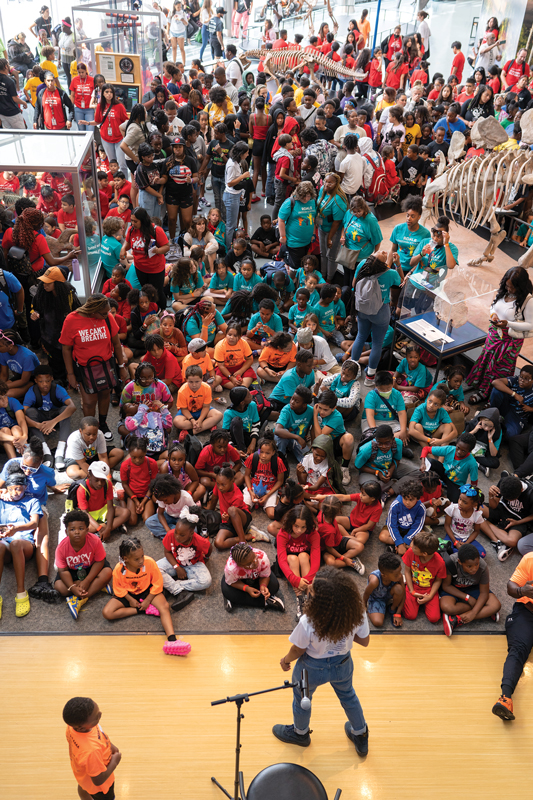
One organization that worked with deepSEE to fine tune its internal diversity efforts is the Science Museum of Minnesota, which engaged trainers to work with several inclusion coaches the non-profit had identified within its existing staff.
The trained Science Museum staffers executed an intercultural development inventory, the results of which were used to create programming aimed at deepening the understanding of DEI.
“They (staff) don’t have an accountability to the coaches,” says Juliette Francis, vice president of mission advancement at the Science Museum. “But certainly, the coaches are available should they want to engage more deeply.”
The organization also worked on and implemented an organization-wide equity and inclusion statement that included acknowledging that the institution, established in 1907, was founded and shaped in a system of oppression.
“The white supremacy culture is very well within the framework of our existence,” she says. “Intentionally calling that out has helped us to say, ‘This is what happened, now where do we want to go with that?”
In order to refocus its own efforts, the Science Museum has engaged with the American Alliance of Museums which has a focus on racial equity in order to help refocus its own efforts. It also reviewed all job descriptions to make sure their expected credentials are actually valuable to the job and reviewed pronouns in order to be as accessible and welcoming as possible.
The museum, Francis says, has received some positive feedback and made some progress in reducing barriers to participation from minority communities.
One example relates to board representation. Its male-to-female ratio had been about 70-30 but is now closer to 50-50. Representation of Black, Indigenous and people of color (BIPOC) is close to 40 percent, up from the low 20 percent range when the work started about seven years ago. Hiring of minorities has also increased.
“We’re making progress,” she says.
But then she adds that it’s been a learning experience that has come with mistakes and that there is still a way to go.
“We have not achieved what we set out to do,” she says. “We learn, we stumble along the way. We learn from those moments. I think that’s an important piece as it relates to our values of equity, learning and collaboration is, this is not a through line. It’s not sequential like you go here to here. This work is work that will far exceed my lifetime. It’s iterative. The risk of doing nothing is not ok. You have to do it, but it will never be perfect.”
Getting people to talk
While others teach through data, Chaz Sandifer has been trying to help business owners learn from each other through the power of conversation.
Sandifer, founder and CEO of theNEWmpls, left corporate America 10 years ago to start a few businesses. TheNEWmpls focuses on racial health and equity through the lens of fitness, wellness and nutrition.
She comes from the perspective of a young Black woman who was raised in Edina by two parents in an upper-middle-class household. But Sandifer is well aware of others who did not have the same access.
Her company partners with chefs to bring nutrition-focused tips to the community, hosts a book club to focus on the mind and offers Wellness Wednesdays for Let Go Let Flow discussions during which white women and Black women participate in panel discussions covering topics of common interest.
“There’s a lot of healing and there’s a lot of turmoil on both sides that we need to bridge a gap,” she says. “We are the pillars of our home, regardless of whether there’s men in the home, we’re there. We are building the foundation.”
Sandifer also started these events as a way to bring together people from different backgrounds to learn from each other.
“It’s a lens of us coming together in a positive way,” she says. “We know the negative. So, we lead with empathy and love and have true storytelling and healing through all of that.”
Also, a business case
While bringing diversity to the workforce is fair and just, there can also be a strong business case. Taylor says research shows most people have few connections in their network with people who are different from them.
“If we continue to look in our own networks, we are going to miss,” she says, adding that when you care about and see the importance of diversity, equity and inclusion, you’re going to attract employees — and customers — who are different.
“Right there, that’s a competitive advantage, that I’ve got a broader pool, that I have people that are more happy, more engaged — because that’s what inclusion is, folks that are more engaged,” she says.
Furthermore, says Hannum, many small businesses want to identify as such for various certifications. In doing so, they are often being required to report on diversity, equity and inclusion numbers, programs and activities as part of maintaining those certifications or, in many cases, to qualify as a partner with many other businesses.
“If you do not meet their expectations, you’ll not be eligible for their business,” she says. “The business case is clear. You understand that and you move what’s possible to develop and grow your business or you don’t.”
Finally, demographics in the U.S. are changing, adds Alex Tittle, founder of DiversityACT. While it’s incumbent upon minority-owned businesses to do their part, to reach out and to do good work, he remains frustrated by those companies and leaders that have fallen back into the same habits of underutilizing potential partners from marginalized communities.
“We’re becoming a more diverse country,” he says. “If we don’t embrace the more diverse country and more open understanding of other cultures and communities, we’re doomed to repeat issues that our country has had over the last 150, 200 years.”