Jay Sachetti joined Jeff O’Brien, partner at Husch Blackwell and Dyanne Ross-Hanson, president of Exit Planning Strategies talked about the market for mergers and acquisitions, exit planning opportunities for companies that don’t end up for sale and how companies can maximize their eventual sale price during an early October panel at the first Upsize on Tap event at Summit Brewing Co. in St. Paul.
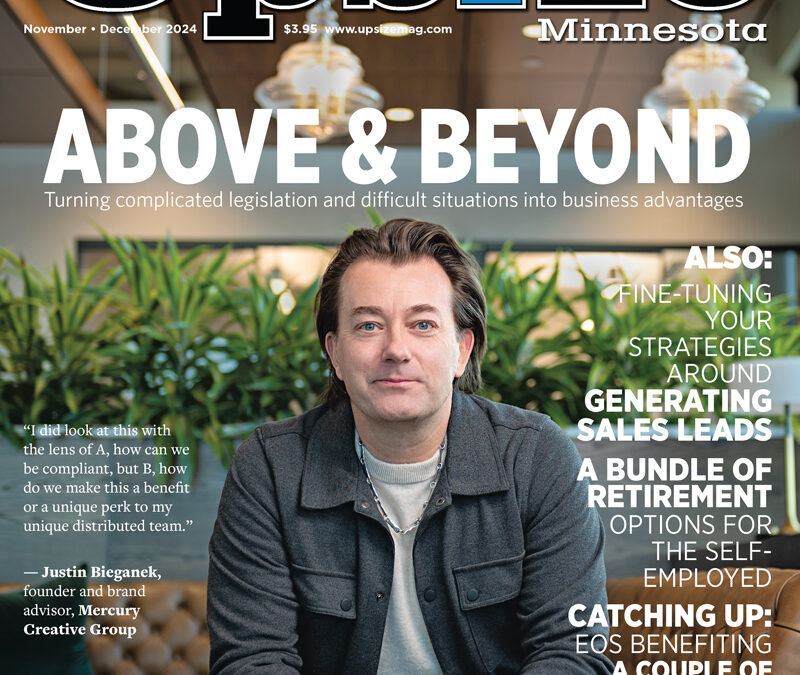
When the state Legislature passed a law requiring employers to provide paid leave and safe time for employees, Justin Bieganek started hearing differing details from friends, colleagues and peers.
1, Artificial intelligence falls short when it comes to replicating nuanced human skills, such as emotional intelligence, empathy, creativity and ethical discernment.
2, Instead of running in fear of AI, focus on how it can augment our abilities and reveal new opportunities.
3, AI can process and analyze data at lightning speeds, providing insights for better and faster decision making, though strategic decisions still need human intuition and experience.
4, History has shown that technological advancements often create new job categories. Roles such as AI ethicists, data scientists and AI trainers are emerging that require a blend of technical and human-centric skills.
As artificial intelligence (AI) becomes increasingly pervasive, it’s natural to feel uneasy about its potential impact on our jobs and livelihoods. People are understandably nervous about AI. Headlines often scream about the impending robot takeover, stoking fears that AI will render human workers obsolete.
Customer service representatives worry that chatbots and automated systems will replace them. Manufacturing workers see robots assembling products faster and more accurately than humans. Even creative professionals like writers and designers feel the pressure as AI begins to generate content and artwork.
The concern isn’t just about losing jobs: it’s about losing purpose and value in a world where machines can perform tasks that once required human intellect and skill. A 2019 study by McKinsey & Company estimated that by 2030, up to 800 million jobs could be automated globally. This statistic alone can cause real anxiety.
Yet, the notion that AI will completely displace humans overlooks one really important truth: despite all it can do, AI can’t replicate our nuanced and deeply human skills. Emotional intelligence, empathy, creativity and ethical discernment are areas where humans naturally excel and AI falls short.
In healthcare, AI can analyze vast amounts of data and assist in diagnosing conditions more accurately than the human eye. However, it cannot replace the comforting presence of a compassionate nurse or the skillful assessment of an experienced doctor who considers not just the data but also patients’ emotional and psychological state.
Instead of running in fear of AI, we should focus on how it can augment our abilities and reveal new opportunities because that’s more of a possibility than it replacing us altogether.
Here are a few ways AI can improve our professional lives:
Enhanced decision-making: AI can process and analyze data at lightning speeds, providing insights that help humans make better decisions. For example, in finance, AI algorithms can predict market trends, but strategic decisions still require human intuition, experience and market condition assessment.
Efficiency and productivity: AI can handle repetitive and mundane tasks, freeing human workers to focus on more complex and creative aspects of their jobs. In marketing, AI tools can manage data analysis and campaign optimization, allowing marketers to concentrate on crafting compelling messages and content.
New job creation: History has shown that technological advancements often create new job categories. The rise of AI is no different. Roles such as AI ethicists, data scientists and AI trainers are emerging, requiring a blend of technical and human-centric skills.
Consider some real-world situations where AI has demonstrated its potential as a powerful tool for growth, hopefully diminishing fears along the way.
Agriculture: Farmers have embraced AI-driven technologies like drones and automated tractors to monitor crops, analyze soil conditions, and manage resources more efficiently. These magical tools help increase yields and reduce waste, ultimately supporting farmers in their core focus.
Retail: In the retail sector, AI-powered recommendation systems enhance customer experiences by suggesting products based on individual preferences. This boosts sales and allows employees to provide more personalized service, focusing on customer relationships rather than just inventory management.
Education: AI is transforming education by offering personalized learning experiences. Intelligent tutoring systems can adapt to each student’s learning pace, providing tailored support that complements the efforts of teachers, whose roles in guiding and inspiring students cannot be replaced.
Ultimately, we control the two primary ways to win in an AI-driven world: embracing adaptability and continuous learning. These human capabilities will determine our personal success and position us to lead in this evolutionary moment.
Here are some ways to learn and adapt with AI:
Commit to lifelong learning: AI is evolving rapidly, and so can we. Think of AI as your new nerdy best friend who’s always ahead of the curve. How do you want to keep up? What new skill are you curious about? Machine learning, data analysis or maybe how to teach your AI to tell better jokes? Focus on an area that makes sense given your interests and work. Perhaps start with a hobby interest as your entry point for AI research. It might feel less threatening.
Merge tech and humanity: Our creativity, empathy and critical thinking are superpowers. AI can handle the grunt work, but it can’t replicate the quirky, heartfelt and downright brilliant ideas that come from the human brain. How are you combining these human qualities with AI in your work? Maybe you’re using AI to analyze customer feedback while you dream up the next big marketing campaign. Or perhaps AI handles the numbers while you focus on building meaningful client relationships. The possibilities are endless.
Stay informed and curious, not alarmed: Understanding AI helps us use it as a powerful tool. What’s your favorite resource for keeping up with AI trends? Many people want to share their knowledge: everything from YouTube videos to podcasts can get you up to speed on terminology and advancements. Whether it’s tech blogs, online courses or a stack of good books, staying informed demystifies AI, making it less of a scary, looming presence and more of a cool, helpful sidekick.
AI is not the enemy. By focusing on our unique human skills and learning to be the drivers of AI, we can navigate this technological pivot point with confidence and curiosity rather than fear. The robots are here, but they’re not here to take over; they’re here to help us be better.