Jay Sachetti joined Jeff O’Brien, partner at Husch Blackwell and Dyanne Ross-Hanson, president of Exit Planning Strategies talked about the market for mergers and acquisitions, exit planning opportunities for companies that don’t end up for sale and how companies can maximize their eventual sale price during an early October panel at the first Upsize on Tap event at Summit Brewing Co. in St. Paul.
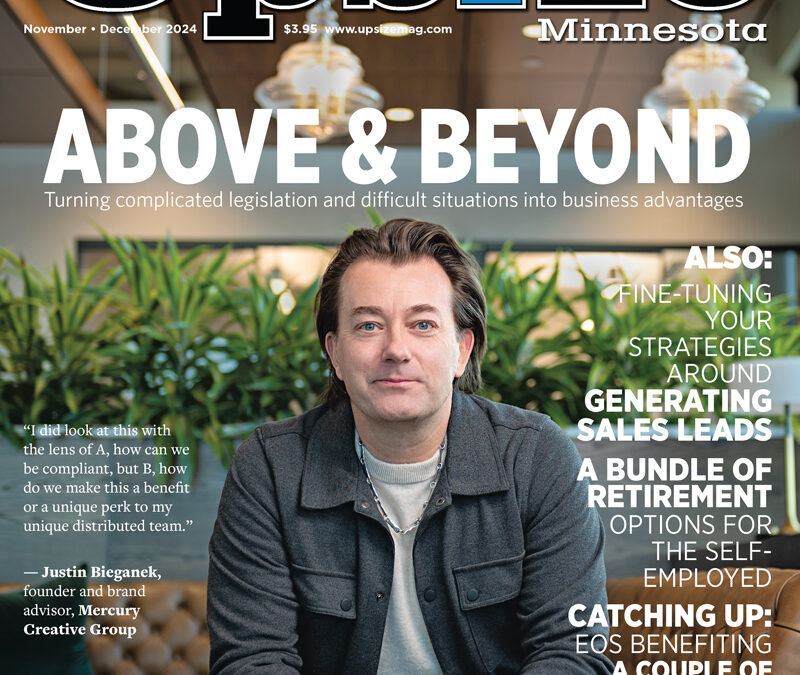
When the state Legislature passed a law requiring employers to provide paid leave and safe time for employees, Justin Bieganek started hearing differing details from friends, colleagues and peers.
CPA and management consultant Kelvin Johnson Jr. was working a freelance job with a local start-up company when he came across the book “The 3-Minute Rule: How Hollywood Storytelling Can Help Your Business” by Brant Pinvidic.
The book discusses how Pinvidic successfully pitched Hollywood using the philosophy that he must be able to clearly and concisely provide all the vital information about his ideas in three minutes or less.
Johnson reached out to Pinvidic for some inspiration and advice and during their conversation, Pinvidic revealed he was looking to create an online course to help teach people his approach. Johnson took it one step further by co-founding Brevity, an artificial intelligence-powered pitch building and refinement platform.
“At that point I thought an online course sounds good, but what I think people need is an action-based pitch software,” says Johnson, who is also CEO of the company. “So, I built it.”
Presenters, whether pitching a banker, a potential investor, in a competition or elsewhere, go into the Brevity platform and type in the pitch goal, audience and duration of the presentation. The software then recommends the number of statements and slides necessary to keep the pitch to an appropriate time — and it customizes the details to the type of pitch, so a three-minute speech for a startup fundraising opportunity would look different from a similarly timed pitch for a networking event.
The program’s trademarked pitch framework, called S.O.U.L., forces the presenter to consider several core concepts: The S stands for “state the target audience and problem,” the O for “outlining how and why your solution works,” the U for “uncovering that proof of potential,” and the L for “listing capabilities and needs.” So far, clients have raised more than $2 million since Brevity launched.
“You have to convey value on time constraints,” he says. “I’m essentially trying to democratize the pitch process.”
Amir Berenjian, co-founder and CEO
of REM5 Virtual Reality Lab
Looking for a unique place for a family birthday party or a date night? How about a virtual reality lab?
Amir Berenjian, CEO and co-founder of REM5 Virtual Reality Lab, left a steady career in investment banking and corporate finance to start the lab. In an 8,000 square foot space in St. Louis Park, REM5 houses several virtual reality pods that can be rented for 90 minutes and enjoyed along with pizza and local brews for a price around $120.
Berenjian’s goal was to make virtual reality accessible to everyone to learn, create and explore.
“I believe in this being the next computing platform,” Berenjian says. “It was not accessible. We needed to be able to show them the technology.”
Since the space opened in 2018, more than 35,000 people have tried the equipment.
“Having this physical space is a game changer,” Berenjian says, adding that getting their hands on the technology will remove uncertainty and make people realize its potential. “We took all the friction out. There is too much friction in the ecosystem right now.”
But that’s not all REM5 is about. REM5 For Good allows for use of the space by students in kindergarten through 12th grade, corporate customers and others looking to learn about the technology.
And currently the company’s largest source of revenue is REM5 Studios, a full-service XR (extended reality, which references all real-and-virtual combined environments and human-machine interactions generated by computer technology) agency, leveraging technology to solve problems. The company, for example, built a virtual Hall of Fame for the Minnesota Twins during the pandemic so fans could use a headset or web browser to be “transported into the Twins’ truly virtual clubhouse” to see artifacts, memorabilia and exhibits.
That business is important because the VR lab itself is space constrained. “If you are a restaurant you are limited by tables, Berenjian says. “The same is true here.”
Thong Nguyen, founder and CEO
of Roomera
Thong Nguyen has been involved in the virtual reality space for several years now largely as the founder and CEO of Roomera, a virtual reality platform that, broadly speaking, helps people see and test the future together.
Initially, Roomera had worked to help organizations minimize the risk of innovation by learning how people would respond to new experiences before attempting to scale. A lot of Roomera’s clients were in the retail and hospitality industries. For example, customers could experience via virtual reality a new flagship Krispy Kreme doughnut store that eventually went up in Times Square.
The company is finishing up a few of those contracts, but is now pivoting toward the consumer side, working on automating its technology and putting it on people’s mobile phones.
“The goal is to provide people with an app that lets them mockup their own space,” he says. “What we’re doing is giving you tools to digitize your space so that you can share that with architects all around the world or whoever.”
So, you don’t like your kitchen?
“We’re building the tools right now that would let you, in a minute, mockup the entirety of your kitchen,” Nguyen says. “Today, households around the world are making billions of decisions regarding their living spaces that will impact their future for years to come. We see an opportunity to make the process inspiring, effortless and accessible — and to bring the world closer together.”
Brad Kautzer, president and CEO
of Williams AV
Williams AV started out as a hearing assistance company working from the founder’s garage. It’s been around for years, steadily serving that market and growing to a mid-sized entity.
But during the COVID-19, pandemic company leaders evaluated its existing offerings and where it could grow in the future. That led Williams AV to finish an artificial intelligence-driven technology that allowed the company to expand into captioning and translation “that support people in an ability to be more communicative,” says Brad Kautzer, president and CEO. “Our mission is to help people by breaking down communication barriers and AI has done just that.”
Accurate captioning and language translation has been a need for a long time, Kautzer says. Programs like Google Translate have been around a while, but Williams AV was able to take some of that base technology and adapt it for customers, both existing and new. So, a client can use the company’s Caption Assist for visual representation of a conversation in the same language or, via Convey Video, can get the conversation translated in real-time into one or more of 127 languages. Accuracy is in the high 90 percent realm, Kautzer says.
The technology has been used in courtrooms, educational settings, beauty pageants, sporting venues and more. “We’ve got reference cases all over the world now.”
Williams AV works primarily through professional AV installers who work with end users, like churches, stadiums, museums, or schools. And both with its current AI-empowered technologies and others in development, AI has greatly expanded Williams AV’s growth expectations going forward. The company sees the market potentially expanding to medical translation services, international business communications, employer/non-native employee relationships and other areas in which such services can break down communication barriers.
“It presents for us an opportunity to go far beyond where we are today in the market spaces and go after more and bigger, more substantial opportunities,” Kautzer says. “It’s just continually opening our eyes.”