Jay Sachetti joined Jeff O’Brien, partner at Husch Blackwell and Dyanne Ross-Hanson, president of Exit Planning Strategies talked about the market for mergers and acquisitions, exit planning opportunities for companies that don’t end up for sale and how companies can maximize their eventual sale price during an early October panel at the first Upsize on Tap event at Summit Brewing Co. in St. Paul.
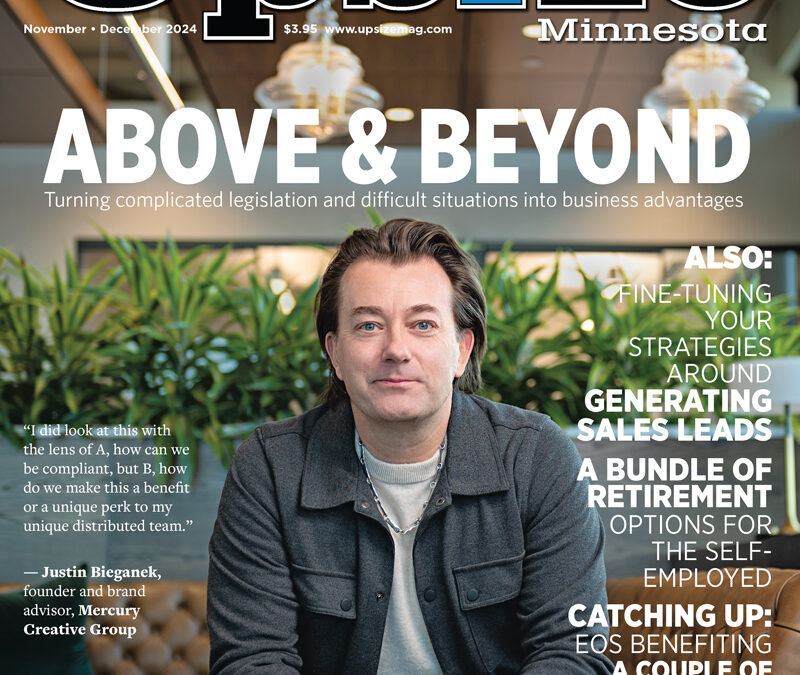
When the state Legislature passed a law requiring employers to provide paid leave and safe time for employees, Justin Bieganek started hearing differing details from friends, colleagues and peers.
Amir Berenjian likens the current state of where virtual reality (VR) headsets are to where the internet was in 1994 or iPhones 10 years ago. The average person isn’t really sure what to make of virtual and augmented reality right now, but he says that’s changing.
With companies like Nike making big VR splashes through conducting virtual shoe try-ons via the Facebook’s Metaverse and equipment price points coming down, it’s only a matter of time, says Berenjian. He left a corporate banking career to help start the REM5 Virtual Reality Laboratory in St. Louis Park, where anyone can go experience a virtual reality headset while having drinks and dinner.
Berenjian, CEO of the lab and sister companies that include REM5 Studios, which is an agency that works with clients on using all forms of virtual, augmented and other extended reality to solve problems, tell stories, build brands and connect humans.
“That’s the fun part about it,” he says.
Really, he adds, if every company convened a discussion, they’d all come up with one or more ways they could use virtual reality to better their businesses. He believes just like late adaptors to previous game-changing technologies, those who don’t adapt will be left behind.
“This technology is not just for technology companies,” he says. “There is not a company that won’t be a technology company in 20 to 30 years.”
Price points, perception changes making VR attainable
REM5 has worked with police departments, putting officers in VR scenarios to train them on de-escalation techniques, done corporate training with large companies on subject like diversity training and taken groups of students on countless discoveries using its headsets. The company can create customized software for some of these experiences, but in others, it licenses already available technology.
That makes it affordable and manageable for organizations that don’t have the budget or time to handle the technology themselves.
“If you’re an 11th grade teacher teaching public speaking, you may be all in on VR being a tool you should be using in the classroom, but you’re not going to manage 25 headsets and software licenses and all the stuff that comes along with it,” he says. “So, you just partner with us. We license the software from the public speaking company.”
That is an option for small businesses. But prices also are coming down, says Thong Nguyen, founder and CEO of Roomera Inc., which is working on creating VR, augmented reality and mobile tools to help people imagine what their living spaces might look like. He’s been involved with virtual reality since 2016 and it’s only recently, he says, where people could go to a retail store and buy a decent headset for around $300.
“That was always one of the limiting factors,” he says. “Not a lot of companies were willing to plunk down thousands of dollars on something that was more of a novelty. So, price point accessibility, usability has gotten within the reach of the consumer.”
That doesn’t mean virtual reality is going to become true reality overnight. It still, Nguyen says, faces the perception that its largest use is its entertainment value.
“Unfortunately, most businesses look at it and they’re like ‘oh, I’d buy it for my kids for Christmas,’” he says. “They tend to think of it as a toy. What they don’t realize is the foundation for business applications is being built right now.”
He compared it to the early days of Apple’s App Store, where it started out oriented toward consumers. Eventually developers realized the business-to-business and business-to-consumer potential for apps.
These changing factors provide a strong likelihood, Nguyen says, that within the next couple years, small businesses might see these technologies as a practical way to solve business needs. It’s already happening among small architectural, engineering and construction firms that “are going to have headsets they use with their clients,” he says, adding that otherwise small business adoption is just starting to uptick in other markets.
So, Nguyen adds, for the basic small e-commerce company? It’s probably premature to get involved in virtual reality. The franchise owner for a Snap Fitness, on the other hand, might find it useful to buy some equipment and get started.
“There’s a lot of fitness stuff that’s emerging within VR right now,” he says. “My honest assessment is that it’s still very early, even though we’re quite a few years in. I think in the next 15 to 20 years, this is basically the new Internet.”
Artificial intelligence on the rise
A little further along on the development scale is small business adoption of artificial intelligence (AI), though Nguyen says those companies typically aren’t developing it on their own just yet.
“Businesses couldn’t hire a $200,000 AI engineer to build this stuff,” he says, adding that small businesses currently utilize AI tools developed by companies that specialize in such developments.
One example of this is Lucy AI, an artificial intelligence-powered knowledge management solution. Lucy, says co-founder Scott Litman, initially tried serving both large and small companies before realizing it was too much and deciding to focus on enterprise businesses.
While Lucy is currently designed for large companies, Lucy itself is a small firm with about 30 employees and Litman himself uses the product. It allows people to save time conducting searches for documents or answers to questions by searching any shared file infrastructure seeking answers. So, rather than taking several minutes or even hours to search through countless files, Lucy returns search results to specific questions in seconds.
“If somebody makes a new proposal or a new RFP response, or our customer success team comes up with a new template for whatever process they’ve got going, they just save it into that file system,” he says. “Lucy is a member of that team that recognizes ‘oh, there’s new stuff, I’ll go read it tonight and I’ll know it for tomorrow.’ … These are very practical uses for how AI is able to benefit us similarly to how it benefits our clients.”
Justin Grammens is founder of Lab651 and host of AppliedAI, a newsletter, podcast and monthly Meetup group aimed at developing the next generation of AI experts. He also publishes a weekly artificial intelligence newsletter called IOT Weekly News. Grammens says as people look to be more efficient with their time, adoption is increasing among small businesses, costs are coming down in a way that makes AI and VR more accessible and several industries, from medical technology to marketing to education, are benefiting.
“You get what you pay for,” he says. “It doesn’t cost a whole lot for you to put a sensor on a piece of equipment that is out in the field and start getting data. And then you just learn from it. You don’t need to go in whole hog and spend a lot of money. Let’s just start with a pilot program.”
That being said, Grammens emphasizes that the AI product is only as good as the operator. “A two-year-old child is smarter than the best artificial intelligence in the world because a child can take a look at a picture and they’ll be able to see a face there,” he says. “Artificial intelligence doesn’t work that way. You have to have shown it millions of pictures of cats and dogs for it to finally realize ‘you know, that looks like a dog.’”
Grammens works with companies to not only get useful data but then also to find intelligent ways to bring that data value via AI. He advises companies that using artificial intelligence “is not a silver bullet,” but should be complementary to their business.
“The beauty of it is that it’s not so much scary or out on the edge anymore,” he says. “A lot of these things have been built and you can use off the shelf software. … People have to understand that there are a lot of really cool things you can do with not a whole lot of money. That’s what I like to talk to companies about is what is possible.”
Local SMB on AI-driven run
One local small business that dove into AI during the COVID-19 pandemic has seen its growth potential explode. Eden Prairie-based Williams AV acquired a company that had begun the process of creating an AI tool. During the pandemic, the company finished its development, using it to establish new translation and captioning services when in-person meetings were on hold, says Brad Kautzer, CEO.
The move has given the company an avenue for accelerated growth, both within its existing customer base but also in newly discovered markets. Several new products are in development and the company is limited only by the resources it has available to develop the products.
“It’s been deliberate,” he says. “It hasn’t been by accident. And it’s not just the technology, but looking at the market and the opportunities and where do we grow with this? It’s been transformational for us.”