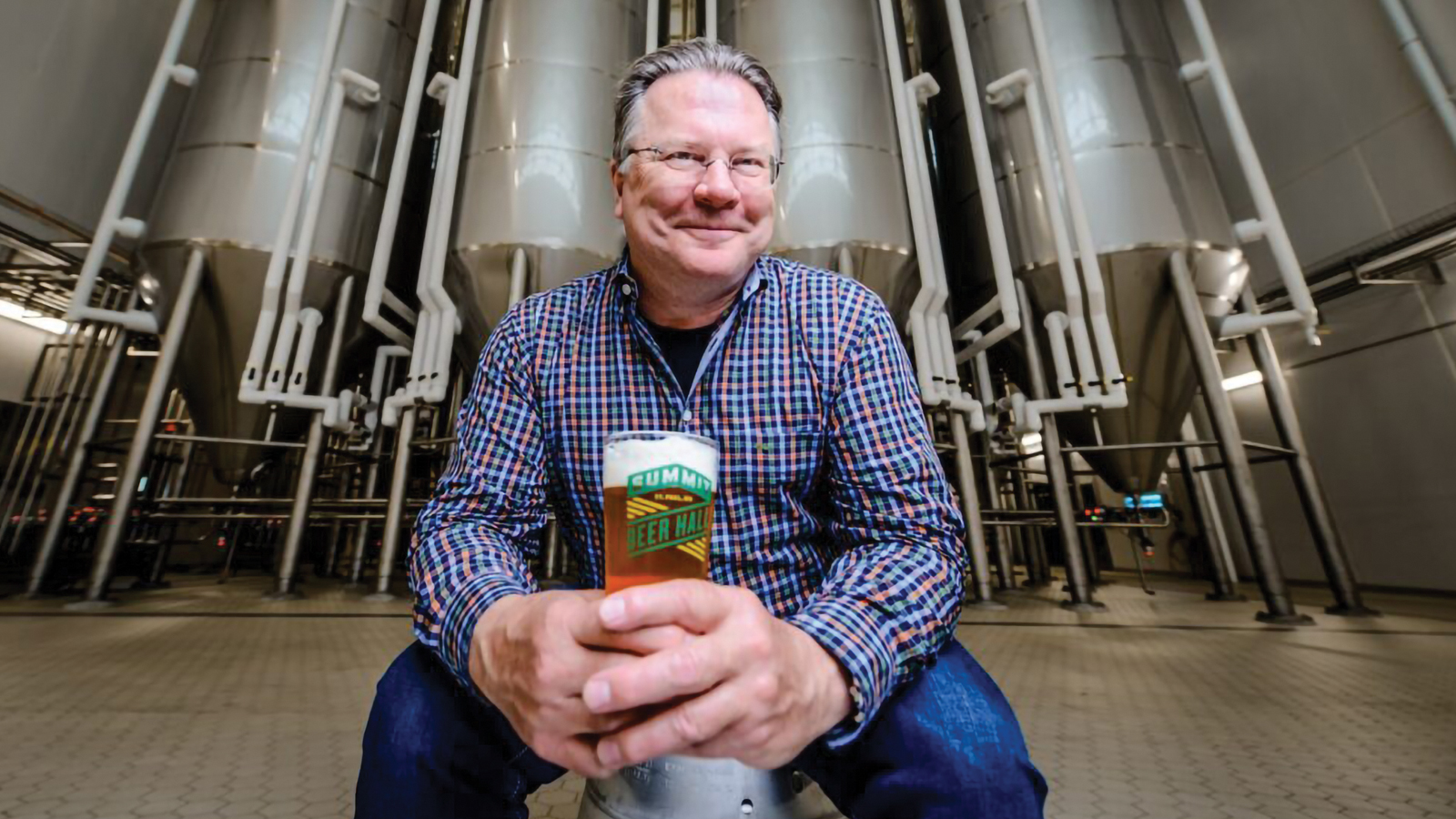
A previous version of this story erroneously indicated Bauhaus has created and is considering further alcohol-based THC beverages. Its THC beverages are non-alcoholic. Upsize regrets the error.
Since Matt Schwandt visited with Upsize in 2017 for a story on standing out in a crowded market, the local craft brewing industry has only gotten more so.
Bauhaus Brew Labs, he said at the time, stood out partially because it focused its product line on longer-to-develop lager beers rather than ales that had been popular with the craft crowd, and also because of a focus on flashy branding and social media messaging.
Social and branding remain important. The product line still includes lagers, but it has evolved significantly, both due to the professional need to keep innovating and the personal situation of its founder.
Bauhaus, he says, was one of the first local breweries to delve into non-alcoholic beer — the fastest-growing segment in beer right now — in part because a medical episode a few years ago forced Schwandt, co-founder and president, to quit drinking alcohol.
“That was a pretty crazy circumstance for someone whose passion for craft beer led them to open a craft brewery,” he says. “At first it was really challenging, but over time I grew to love not drinking. It’s just who I am today.”
Personal trials bring professional gain
While he’s adapted well to not drinking, the change did pique Schwandt’s interest in diversifying into other beverage categories, particularly within beer.
Bauhaus did so in 2018 in tandem with Ben Jordan, CEO of ABV Technology, the St. Paul-based company that designed a machine that removes alcohol from beer “while retaining a lot of the great flavor profile you want in a beer so that it actually tastes like the real thing,” Schwandt says. “He approached us in the fall of 2019 and said, ‘Hey, would you be interested in trying to brew a craft scale nonalcoholic beer?’ I thought, ‘Hmm. That’s really interesting.’”
After a few test kegs, Schwandt says, “It turned out way better than I ever expected.”
So, Bauhaus launched Nah to heavy acclaim. The company has added two more non-alcoholic products and intends to introduce a fourth later this year with the idea of marketing a four-variety mix-pack.
He might have gotten there anyway but acknowledges his own health situation probably got Bauhaus there quicker, ahead of most of the industry.
Schwandt readily acknowledges one lesson he’s learned — and one of importance to any small business owner in any industry — is to be more on top of cash flow and general finances. The introduction of non-alcoholic beers to Bauhaus’s product mix have significantly improved the company’s financial outlook, growing to about 10 percent of sales — definitely useful in an industry where even some large powerhouse breweries have been closing down in recent months.
And, he adds, distributors in other markets that pay little attention to out-of-state craft beers have called to talk with Bauhaus about adding their product line due to the availability of non-alcoholic products. The company launched in Colorado in January with its full slate of products, an opportunity that likely otherwise wouldn’t have been available.
“I am always interested in innovation,” he says. “I think my personal situation made it more of an appealing thing for me to just try. And I’m really glad we did.”
High on THC
Schwandt, who first was a homebrewer, then was a lawyer before starting Bauhaus, testified at several legislative committee hearings in St. Paul as lawmakers worked through legalizing cannabis. His legal background came in handy.
And Bauhaus dove headfirst into that newly growing industry, as well, introducing several varieties of a THC-infused beverage called Tetra. Those non-beverages have gotten significant interest from around the country.
“I think we’re one of the only producers doing a non-alcoholic beer with THC right now,” he says. “There have been a handful of others that have done really small-scale versions of something like that, but we’ve done it at a full-scale production batch.”
Schwandt says that’s likely another area of continued growth for Bauhaus. He pays attention to a lot of the insights published by the Brewers Association Chief Economist Bart Watson, who regularly provides trend information on areas of opportunity for the industry.
He’s also regularly monitoring consumer product and ingredient publications.
“I’m kind of a market research geek,” he says. “I like seeing what’s going on out there and what could be the next big thing.”
Stepping aside?
Schwandt used to do all the recipe formulations for Bauhaus. He’s still involved but has a seven-member leadership team among the brewery’s 24 employees who meet weekly to discuss opportunities for innovation.
“We’ll have brainstorm sessions like, how can we do this most effectively,” he says. “And how can we make this fit under the Bauhaus umbrella? Our team has become really capable and organized at getting results.
So adept, in fact, that he’s starting to look for his next adventure. The father of a 14-year-old son and a 13-year-old daughter, both of whom are competitive swimmers, Schwandt’s free time is limited. Which has him considering returning to the more stable and predictable practice of law.
With his personal and professional interest in THC and non-alcoholic beverages, cannabis law may be up his alley. What impact that would have on his day-to-day involvement with Bauhaus is up in the air.
“I’m comfortable now knowing that our staff is adept at the day-to-day, where I could probably take a step back and take more of an advisory role,” he says. “I’m just doing my best to try to take this industry as it comes, trying to see around corners where I can and, when the uncertainty kicks in, I just sit back and remember we have had a formula that has allowed us to last 10 years.”