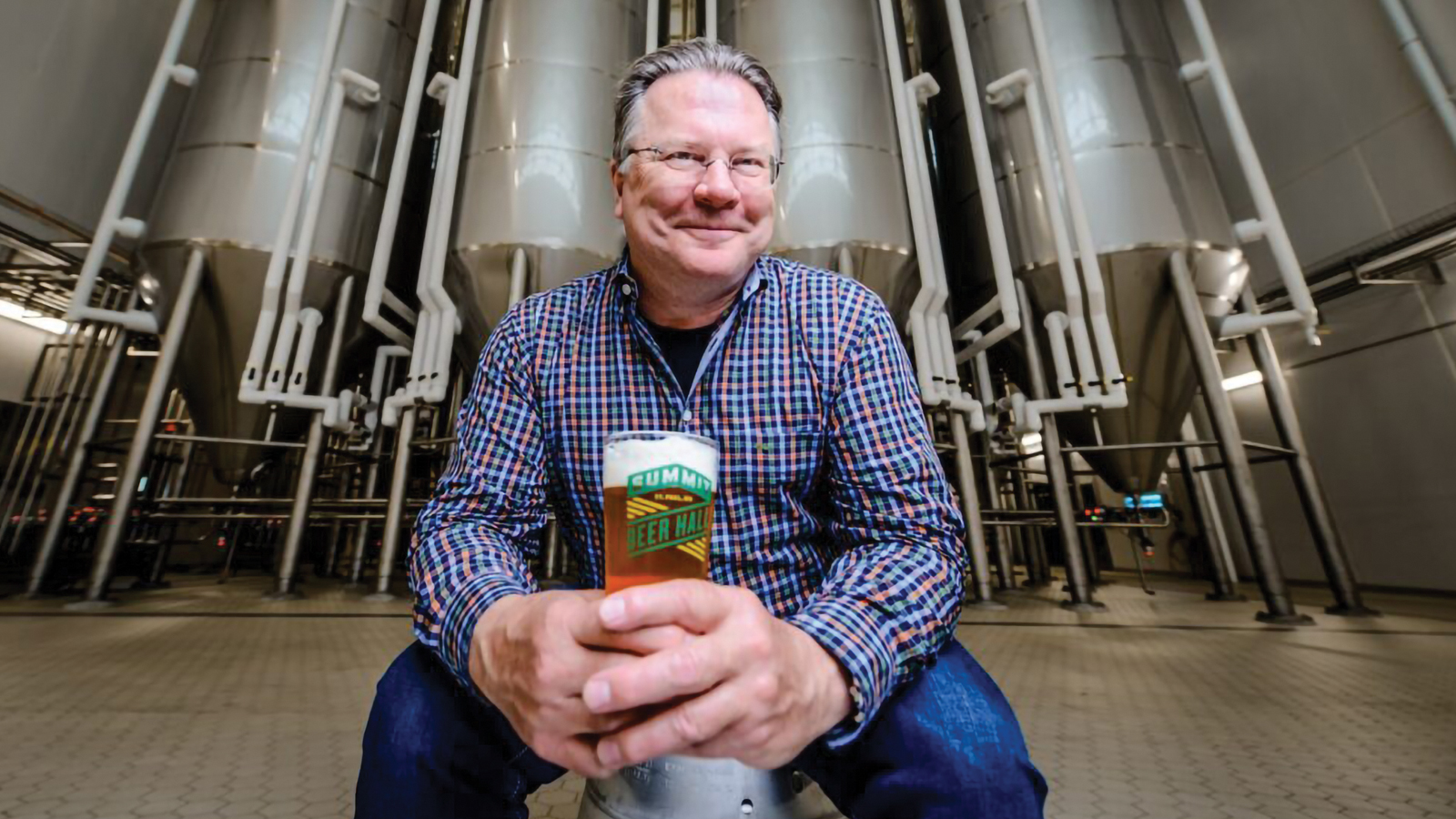
When Mark Stutrud decided in the early 1980s to pass up a master’s degree in social work to open a microbrewery, the initial feedback wasn’t good.
His father thought he was crazy. And the head of the Brewers Association of America, to which Stutrud was applying for membership, wrote a letter back discouraging him from moving forward.
“Please know that I am not encouraging you to do so, because it is a long and hard road that you are planning to go down,” wrote William O’Shea, executive secretary at the time.
That now-framed letter decorates a wall in the entryway to Summit’s corporate headquarters in St. Paul. Stutrud holds no ill will — O’Shea was actually looking out for him, he realizes, as there were just nine microbreweries in the U.S. at the time.
“It was certainly more polite than what my father told me when I told him I was going to start a brewery,” Stutrud quips. “My dad had heard a lot of different ideas from me and he just kind of shook his head and he said, ‘This is the craziest ass idea I’ve ever heard.’”
It’s easy to laugh about those early doubters now. Stutrud founded Summit Brewing in 1986 in a building along University Avenue in St. Paul, producing around 1,500 barrels of beer a year with a capacity of about 3,000. When he started researching the concept a few years earlier, there were only nine craft breweries in the U.S.
About five years later, the company started showing some profit. After outgrowing its initial location, Summit acquired land in the Crosby Lake Business Park near West Seventh St. and Interstate 35E along the Mississippi River, for $1 from the Port Authority of St. Paul.
The company broke ground in 1996 at the location, moving into its new digs in 1998. It has, in the quarter century-plus since, invested north of $50 million in expanded brewing facilities, building out a tap room, adding canning capabilities and continuing to add to its full menu of award-winning beers.
Fantastic growth
Capacity is now around 240,000 barrels annually. Actual production peaked at around 135,000 barrels but has dropped a bit in recent years down to 80,000 as the entire industry has dipped while wine and spirits have become more popular.
Stutrud also points to a pull-back in 2017. Summit, at the time, was distributing in 17 states but was struggling to make money in states like Ohio that were further away from headquarters.
“Our sales trends were great,” he says of that market. “We were losing money because of having feet on the street, having an expense account, doing promotions. The issue is that when you’re in small-scale brewing, the further you get away from the brewery, that identification with the product becomes more distant.”
The saturation of the craft beer market locally and nationally and consolidation in the distributor pool — down from 6,500 to 2,500 in about a dozen years, he says — has also created challenges.
The entire beer industry has been in decline in recent years and Summit has felt that. So, in 2017, the company pulled out of several markets to focus on Minnesota and its neighboring states in each direction.
“Ninety percent of our sales continue to be in Minnesota and, remarkably, just shy of 70 percent are in the metro area,” he says.
So, has it been successful?
Stutrud is preparing to move into a different role and he spent some time reflecting on his initial goals and where the company stands now. Has it been successful? Not a completely straightforward answer. Sure, Summit rebirthed an appreciation for craft beer in the market — the Brewers Association indicated in 2022 there were more than 9,500 craft breweries in the U.S. — and has introduced several award-winning beers.
And, through a focus on quality and social responsibility to the consumer that he admits sometimes takes the fun out of visiting other breweries, Summit has built a loyal following. But the company hasn’t achieved the market share Stutrud dreamed was possible.
“Has Summit been successful in terms of developing, fostering a new industry? Absolutely,” he says. “Do we excel at what we do when it comes to the style and quality and integrity of our products? Absolutely. Have we truly focused on human capital and fostering an absolutely positive work culture and workplace? Absolutely. For every year that we’ve been in existence, have we been financially successful? Not necessarily. When you think about defining success, there are many layers.”
That’s one of the lessons he’s learned over the years. Success comes in many forms. It looks different to different people and the bar moves over time through company and personal growth.
“Success is something to keep in context because there are many layers and different experiences of being successful,” he says.
The vision
While it hasn’t gotten quite as big as he’d hoped, Summit’s still come a long way since Stutrud launched the brand nearly 30 years ago.
Leading up to its opening, he spent a couple years finding mentors, using his work vacation to do apprenticeships with experienced brewmasters and eventually graduating from the Siebel Institute of Technology, a vocational school in Chicago focused on brewing.
“If I’m going to make something, I sure as shit should get educated on how to do it right, whether I’m going to make a car, a shoe or tortillas,” he says. “That’s what a craft is all about.”
His goal was to reestablish a true beer culture in this country beyond the “great American Lager” on which the big brewers focus.
Though he prefers craftier beers, he will never bad mouth the big players, both because they helped him out with product testing and learning the craft in his early days and because they’ve left a lot of market open for the Summits of the world.
“I’ve never criticized the big brewers for what they do,” he says. “They’ve got that down to a science. And, I would say, make more of that, because you’ve created an opportunity for little breweries to get back into very traditional styles.”
He’s got an unquenchable focus on product quality and integrity that he admits sometimes takes the fun out of visiting other breweries. He tries to stick to the basics and “not get too heady in terms of theory and … making sure that you’re observing and not perceiving,” Stutrud says.
Bright future ahead
As he prepares to step down as CEO Stutrud is bullish on Summit’s future and he’ll be a part of it.
Chief Strategy Officer Brandon Bland will replace him as CEO, but Stutrud will remain involved, working closely with distributors and retailers.
“I’ll be spending the majority of my time with the sales team on the street, connecting with our customers in a meaningful way,” he says, adding that he’ll also keep tabs on the state Capitol, reporting back on issues of importance.
Meanwhile, Summit has plenty of options for future growth. The company is making significant inroads in non-alcoholic beer, a segment expected to grow annually by more than 5 percent a year for the next decade, according to Global Market Insights.
“We’re going to be adding to that family next year, another style,” Stutrud says.
Summit is also researching THC-infused beverages, though, in keeping with the standards the company has set for itself, he says it won’t go there until there are more quality standards in place.
“We’re taking a deep dive on what needs to be approached to produce a shelf-stable product that is consistent and we’re exploring the technical and the science sides of THC beverage production,” he says. “We’re producing a food product. Beer is a food product. People ingest this and, when you’re making something that people put in their bodies, that’s a huge responsibility.”