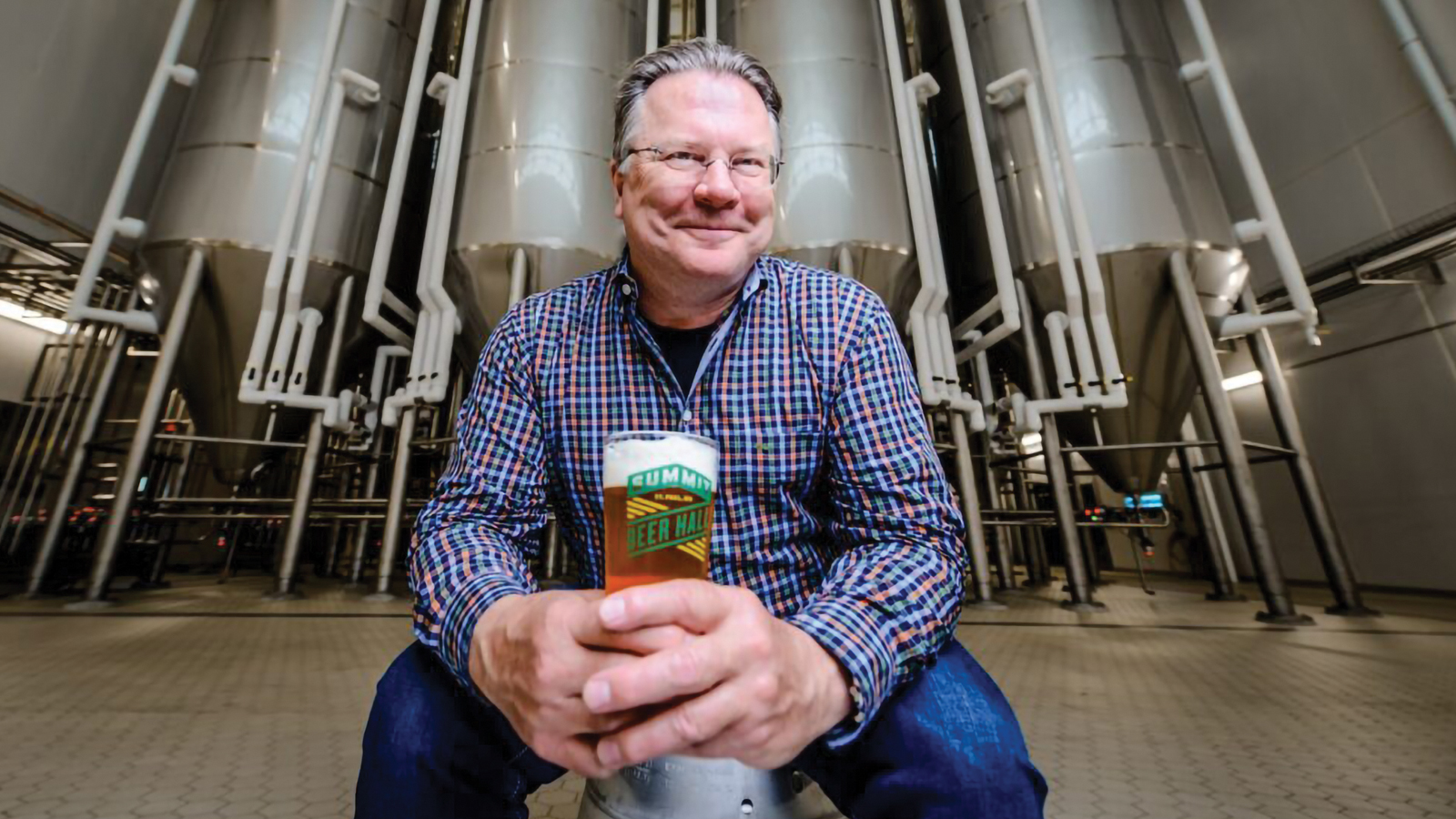
Jay Sachetti joined Jeff O’Brien, partner at Husch Blackwell and Dyanne Ross-Hanson, president of Exit Planning Strategies talked about the market for mergers and acquisitions, exit planning opportunities for companies that don’t end up for sale and how companies can maximize their eventual sale price during an early October panel at the first Upsize on Tap event at Summit Brewing Co. in St. Paul.
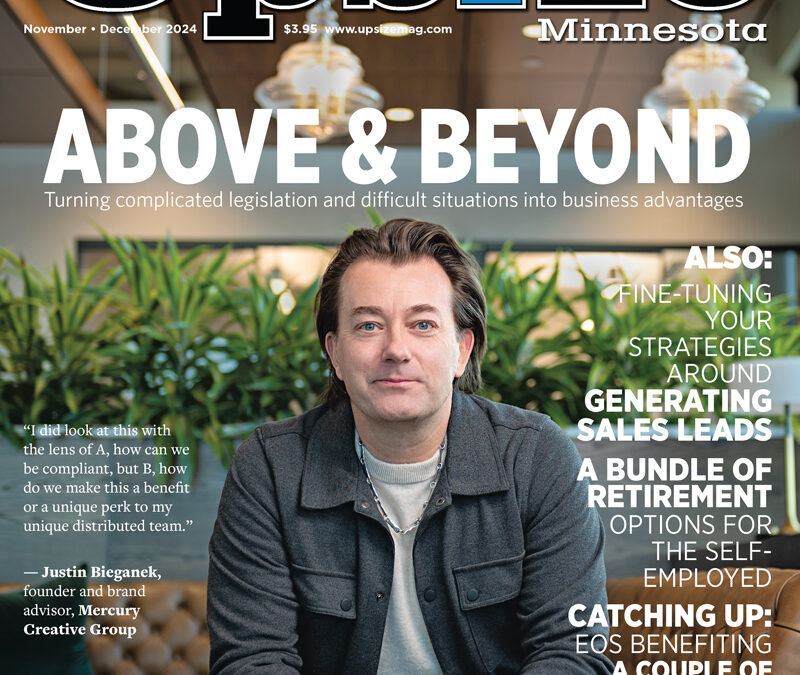
When the state Legislature passed a law requiring employers to provide paid leave and safe time for employees, Justin Bieganek started hearing differing details from friends, colleagues and peers.
Tom Salonek founded tech consulting firm Intertech in 1991 out of his spare bedroom after finding his previous job demoralizing.
The first man in his family to go to college, he’d built the business to 70 employees and $14 million in revenue by 2017, when he was Upsize’s Business Builder of the Year.
It’s continued to be a steady six-year climb since. Intertech enjoyed a record 2022, bringing in $16 million in revenue and continuing to build strong account diversity and retention on the technical and sales and marketing sides of the business.
More than 90 percent of its revenues come from consulting and application development, where companies contract with Intertech to build software.
There have been a few times over 30-plus years where the company has looked at building its own framework for a product it could market and sell independently in bulk,but it’s a different business from selling a service, Salonek says.
Intertech’s customers have included Wisconsin-based retailer Menard’s and the Minnesota Bureau of Criminal Apprehension.
“At the end of it, it’s work for hire,” he says. “They own it and we do not have a financial interest in what we build.”
While the company has done work for large entities like NASA, 3M, Microsoft and several branches of the U.S. military, Salonek prefers working with smaller and mid-market companies, where it’s possible to build relationships and make a tangible difference.
“If I was to go to my class reunion and say the names of our customers, most people would scratch their heads and say, ‘I’ve never heard of it,’ although that could be a seven-figure customer for us,” he says.
It’s harder with larger organizations, where when bidding “you are rated on how cheap you are and how quickly you can start throwing applicants at them,” he says. “When we work with a mid-market company and we build something that is significant to them, that really moves the needle. That’s where we build long-term relationships with customers.”
Thriving through COVID
Intertech did lay off a few employees during COVID, but survived in good shape. Most employees, including Salonek, already were working remotely at least part time.
“We were good to go,” he says of the sudden flip to 100 percent remote work. Now, when he does go in the office — far less frequently than the three days he went in prior to COVID — there’s only a smattering of employees.
“I think people really like the flexibility of being able to duck out for a dentist appointment in the middle of the day or have lunch with their kids,” he says. “When things got better and we could be back together in person, there were some people that said, ‘If you force me to come into the office I’m going to quit.’”
A nearly empty building might present a problem for some, but Intertech owns its space. Its balance sheet is in good shape. And, because customers have gotten more flexible about not needing employees in the office full-time as well, the pandemic actually opened it up to take on both employees and clients spanning a wider geographic reach.
Evolutions and lessons learned
Intertech is running so well, Salonek says, that while he stays connected with his team, he’s increasingly been able to step back, exit overseeing the day-to-day operations and make sure he is present for his teenage kids.
He’s built a strong leadership team with solid educational and professional backgrounds who know the business and complement him.
They have one-on-one meetings every other week and talk at the end of the day three days a week to make sure everyone is aligned. They have also invited all employees, local and remote, to the office for some business and leisure meetings.
“They’ve been around a while and they’re really good at what they do,” he says. “Those things really allow me to not be involved in the minutia of the day-to-day but still be very aware of what’s going on in the organization.”
That’s not to say there have not been challenges or changes. Intertech did, for example, exit the face-to-face or live instructor-based education business, which had already gotten tougher prior to COVID.
“With the sub-35 demographic, when it comes to learning, if you said, ‘You have to learn something technical, what would you do?’ sitting down in a classroom for three to five days doesn’t make the list,” he says. “It’s like, ‘I’d use YouTube, I would look at a coding site, I would get an on-demand whatever.’ We occasionally do delivery through a partner, but we do not proactively sell any of those education services.”
Intertech also had to streamline what he’d previously called an eight-step hiring process. Born from some early hiring mistakes, Salonek created a detailed process that asked between 20 and 30 hours of a candidate’s time. The last couple years, as hiring has gotten tougher, he found applicants often would arrive at interviews already holding a couple offers.
The company still utilizes all of the steps, which include team interviews, technical interviews and personality assessments. Salonek doesn’t make offers to someone who has not interviewed because he believes the amount of time employees spend together warrants some time spent upfront getting to know each other.
But where the steps used to be separate and days apart, they’ll now go through multiple steps in the same day, “So you’re making a decision in a couple days instead of a couple weeks,” he says, adding that he worked with his colleagues and a recruiting team on the streamlining.
It feels like the middle ground, he says. He can make sure that as the company grows, the culture evolves with it. With strange things happening in hiring, like people hiring proxies to interview for them, Salonek says some time upfront is a worthwhile investment even if it costs him a hire.
“When you look at this revised process and they still say, ‘I’ve got two in hand, I just want an offer,’” he says, “Well, then you’re not a good fit because culturally we’re not there.”